




Twenty-three years ago, on the last matchday of a relegation battle in Chiapas, journeyman midfielder Gilberto Mora Olayo did something that had little to do with talent and everything to do with will. Jaguares needed a win over Tecos to survive in Mexico‘s top flight. The regular free-kick taker had already put one off the crossbar. Mora walked over and struck the next one into the top corner. Jaguares stayed up 1-0, the one thing anyone in Chiapas football remembers him for.
Five years later, in that same city, during his father’s six years in Jaguares, his son was born.
The making of “Morita”
The boy grew up on a dirt pitch in Chiapas, joining the Jaguares youth school at four with his father as a coach. The family later moved to Tijuana’s Otay district, hard against the border fence. Antonio Rodriguez, now Tijuana’s goalkeeper and captain, recalls a training drill where the ball reached a boy he didn’t recognise: one touch, a turn, the defender gone. “It left me in shock,” he said.
Youngest to debut for Club Tijuana, at fifteen, then the youngest goalscorer in Liga MX history twelve days later. Youngest to debut for Mexico’s senior team, at sixteen. Youngest player of any nationality to win a senior international trophy at the 2025 Gold Cup, ahead of Yamal and Pele. This June he became the youngest player to appear for Mexico at a World Cup, breaking a record that had stood since 1930. He is known, almost universally, as Morita.
The records are the least interesting thing about him. Santiago Gimenez, Mexico’s senior striker, described a team bus during last year’s Gold Cup: everyone on their phones, and then Mora, reading a book. “That’s when I thought, this guy is different,” Gimenez said. He is seventeen, still studying for university entrance while Europe’s biggest clubs price what he might be worth in three years.
Gilberto Mora is just 17 years old playing this good at the World Cup but because he’s not Lamine Yamal you guys are mute about it pic.twitter.com/Xzuc9uRtPS
— 𝔸𝕝 𝕍𝕒𝕣𝕠 𝕏 (@al_varo777) July 1, 2026
Juan Carlos Osorio, who gave him his senior debut at fifteen after one scrimmage, said Mora reminded him of Andres Iniesta, the turn and release as one motion. Rodriguez put it differently: “He hasn’t gotten dizzy, hasn’t been distracted by what’s said about him. He’s still the same.”
The Bellingham storyline takes over
That Iniesta comparison has since crossed the Atlantic. English press coverage ahead of Sunday’s Round of 16 tie has reportedly leaned on the same name, alongside apprehension about facing Mexico’s midfield, a note of respect Mexican outlets have amplified all week.
The dominant pre-match narrative in Mexico now isn’t the scoreline. It’s Mora against England’s midfield trio of Jude Bellingham, Declan Rice, and Elliot Anderson, framed by TUDN, ClaroSports and Récord as one of the most complete lines in the tournament.
Story continues below this ad
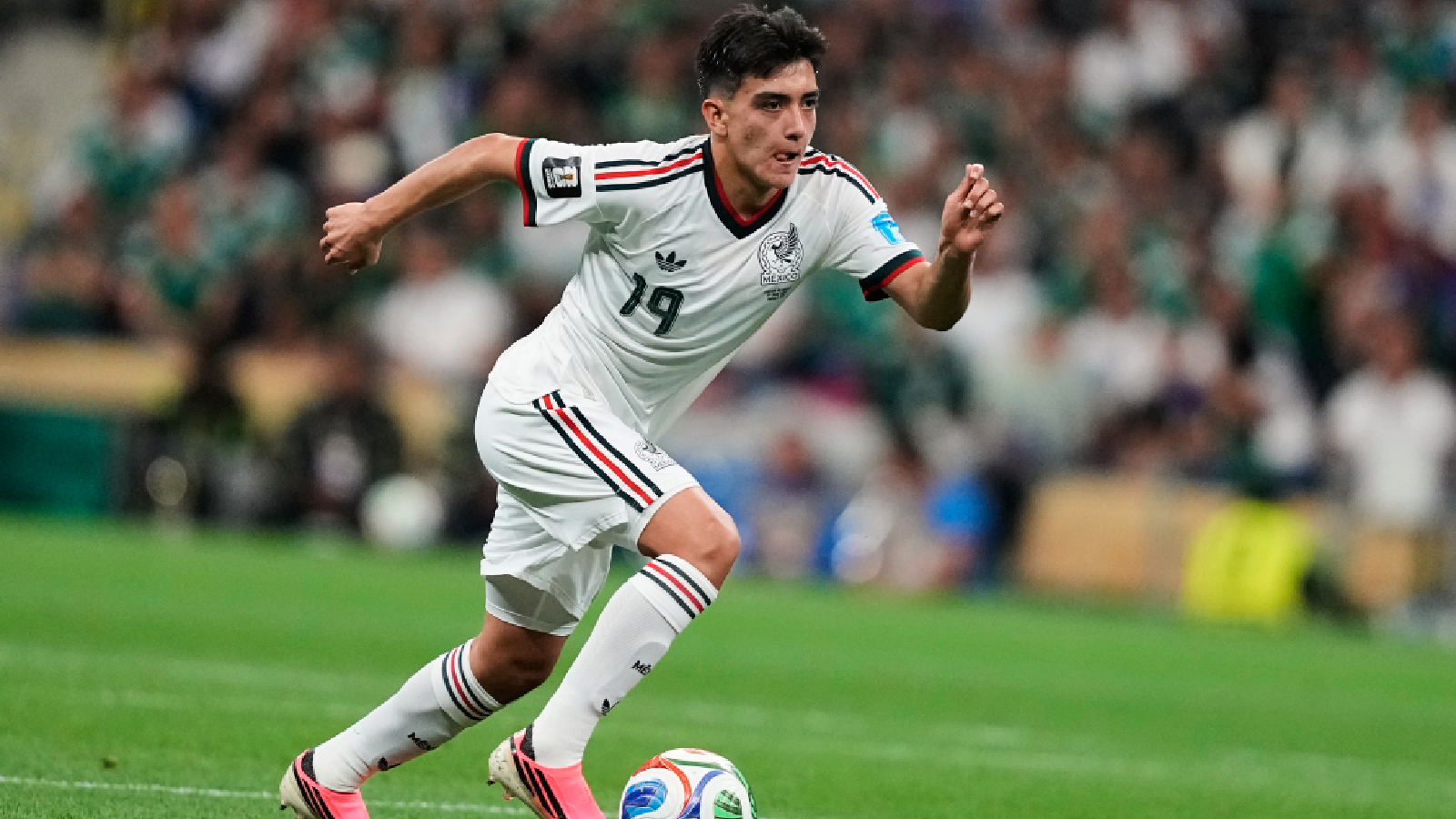 Mexico’s Gilberto Mora (19) runs with the ball during the World Cup Group A soccer match between Czechia and Mexico in Mexico City, Wednesday, June 24, 2026. (AP Photo/Natacha Pisarenko )
Both players debuted in their national top flights before turning 17, and both are cast by their own countries’ press as the present and future of the team. A warmer footnote is circulating too: in an old fan interview, Mora named Bellingham as the player he would most like to share a pitch with one day. Sunday, he gets the chance early.
Manchester United has reportedly joined Real Madrid and Barcelona in monitoring him, though nothing can move until October, when he turns eighteen.
On the pitch
At this World Cup, Mora played a brief cameo against South Africa, then nothing against South Korea. Mexico had already won the group, but Aguirre started him against Czechia anyway. Mora was slow for a half, then wasn’t: a shimmy that opened a chance somebody else missed, then the pass that split Czechia’s defence for Mexico’s second. He left late to a standing ovation, in the same match that brought on Guillermo Ochoa, forty years old and at his sixth World Cup, for a farewell cameo of his own.
Four days later, against Ecuador in the Round of 32, Aguirre started him again. Mexico won 2-0, with Mora posting 88 percent pass accuracy, five recoveries, three chances created and an 80 percent duel-win rate. He became the second-youngest player in World Cup history to start a knockout match, behind Pele.
Story continues below this ad
That generational thread between Mora and Ochoa has found its way into the meme economy too. An AI-animated short circulating on TikTok and X imagines a childlike voice, Mora’s, asking his mother’s permission to play Sunday, name-checking “don Memo” Ochoa as the reassuring elder in the room, a nod to the “el niño” nickname and the real gap in the squad: Ochoa’s sixth World Cup at forty, Mora’s first at seventeen.
The uncomfortable footnote
There is one part of this story Mexican football would rather not examine too closely. Asked last year whether he felt more tijuanense or chiapaneco, Mora didn’t hesitate: “Más tijuanense ya”, more Tijuana than anything, by now. It cost him something at home. Chiapas social media called it a betrayal; he later said he was proud of Chiapas too. One columnist named the discomfort outright: Mexico claims Chiapas once a native succeeds elsewhere, and is less interested in why its most gifted children keep having to leave to do it.
Twenty-three years before any of this, his father stayed behind after training, alone, two or three evenings a week, set up a moving wall himself, and practised the same free kick over and over on an empty pitch, for no one.