






This train flies above the tracks — and will cut Tokyo-Nagoya travel to 40 minutes


3 min readUpdated: Jul 9, 2026 02:52 PM IST
Maglev train in Japan: Japan has approved the construction of a new high-speed maglev train line connecting Tokyo (Shinagawa) and Nagoya. According to The Japan Times, Shizuoka Governor Yasutomo Suzuki informed the assembly on Tuesday about the planned construction of the Shizuoka section of the Chuo Shinkansen maglev line, ending a nine-year deadlock. The project had been stalled since 2017 due to concerns over its potential environmental impact.
According to the report, the Shizuoka section is considered to be the most challenging part of the Chuo Shinkansen maglev line, which will connect Tokyo’s Shinagawa Station with Nagoya Station in Aichi Prefecture.
Maglev train in Japan to cut Tokyo-Nagoya travel time
According to Central Japan Railway Company (JR Central), the new maglev train will operate at a maximum speed of 500 kmph. The Chuo Shinkansen maglev service will reduce travel time between Tokyo’s Shinagawa Station and Nagoya Station to around 40 minutes, while the journey from Shinagawa to Osaka will take only about 67 minutes.
Currently, the journey takes about 86 minutes from Tokyo’s Shinagawa Station to Nagoya and about 134 minutes to Osaka on the Tokaido Shinkansen, which has been in operation for more than 60 years.
.
Shinagawa to Nagoya, and on to Osaka
Shinagawa
Nagoya
Osaka
🚉
The Chuo Shinkansen maglev line will run via Kanagawa, Yamanashi, Shizuoka, Nagano and Gifu prefectures. Top speed: 500 km/h. Levitation height: about 10 cm above the guideway.
Nine years to a breakthrough
.
2017
Construction of the Shizuoka section stalls over concerns about the project’s environmental impact.
.
2021
Estimated construction cost is revised up to ¥7 trillion.
.
Oct 2025
Cost estimate rises again, to ¥11 trillion.
.
2026
Shizuoka Governor Yasutomo Suzuki tells the prefectural assembly construction of the Shizuoka section will proceed — ending the deadlock.
.
2036
JR Central’s expected opening year for the Chuo Shinkansen maglev line.
The Shizuoka section is considered the most technically challenging stretch of the entire line.
How much time the maglev saves
Shinagawa → Nagoya
Shinagawa → Osaka
The Tokaido Shinkansen has been in operation for more than 60 years. Bars scaled to relative travel time.
A project that keeps getting costlier
Initial
¥5.5 trillion
Original construction cost estimate
2021
¥7 trillion
Revised upward
Oct 2024
¥11 trillion
Latest estimate, citing challenging construction conditions
Source: JR Central Report 2024. Figures reflect construction-cost estimates, not final project cost.
The Superconducting Maglev System
The train levitates about 10 cm above the guideway using magnetic force — no wheels or rails ever touch.
⚡
Superconducting magnets on the train interact with coils along the guideway
❄︎
Cooled below a critical temperature, electrical resistance vanishes — “superconductivity”
🚊
Strong propulsion force lets the train reach a stable 500 km/h
🏙︎
No wheel-rail contact is designed to operate safely in earthquake-prone Japan
Five prefectures on the line
Tokyo (Shinagawa) Kanagawa Yamanashi Shizuoka Nagano Gifu Aichi (Nagoya)
Shizuoka, highlighted, was the site of the nine-year construction deadlock and is considered the most challenging section of the entire route.
Sources: The Japan Times · Central Japan Railway Company (JR Central) Report 2024.
.
This new high-speed line will link Shinagawa and Nagoya via Kanagawa, Yamanashi, Shizuoka, Nagano and Gifu prefectures.
JR Central now expects the Chuo Shinkansen maglev line to open in 2036. According to the report, the estimated construction cost has increased significantly due to challenging construction conditions. The initial cost estimate of ¥5.5 trillion was revised to ¥7 trillion in 2021 and further increased to ¥11 trillion in October last year.
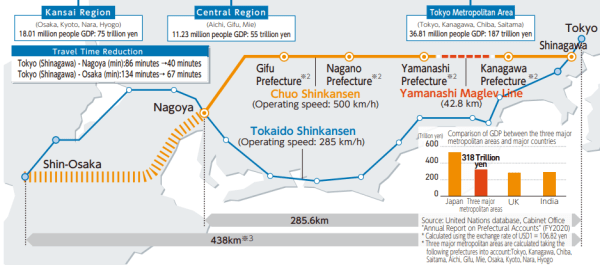 Source: JR Central Report 2024
What is a Maglev train? Inside the technology behind Japan’s 500 kmph high-speed train
According to JR Central, the Superconducting Maglev System is an advanced Japanese technology that allows trains to run without touching the rails. Unlike conventional trains that use wheels and tracks, maglev trains use magnetic forces between superconducting magnets on the train and coils along the guideway.
Story continues below this ad
“To obtain a strong propulsion force, the superconducting magnet utilizes the “superconductivity” phenomenon, whereby electrical resistance vanishes when a particular substance is brought below a certain temperature, which enables the vehicle to levitate about 10 cm, making it possible to operate safely in earthquake-prone Japan. These features make it possible to travel at an ultra-high speed of 500 km/h in a stable manner, unlike conventional railways,” it said.
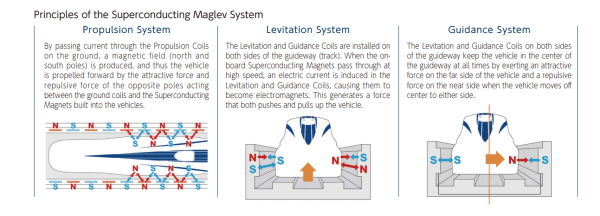 Source: JR Central Report 2024


Stay updated with the latest – Click here to follow us on Instagram
