





How Nirmal Purja raced against time to save a stranded climber on Annapurna


World-renowned Nepali climber Nirmal Purja, who was also a former UK special forces member, was confirmed dead on Saturday after an avalanche struck his expedition on Pakistan-Occupied Kashmir’s Broad Peak on Thursday, killing nine other climbers. But one of the most astounding stories about the mountaineer isn’t about a summit; it is about trying to save a life.
Purja held multiple records to his name, but his most famous achievement came in 2019, when he climbed the world’s 14 tallest peaks in just over six months, a project he called Project Possible.
It was in April 2019, hours after summiting Annapurna, the first peak on that list, that Purja learned a Malaysian climber, Dr Chin Wui Kin, was missing on the mountain.
The Annapurna rescue came during Purja’s record-breaking Project Possible expedition and remains one of the most celebrated high-altitude rescue missions in modern mountaineering.
By his own telling, the moment could not have caught him less prepared. “We got back down to base camp probably around 10 pm. Of course, because we had summited we had a few friends waiting for us, and they gave us whiskey and we drank until, like, 3:30 in the morning,” Purja later told National Geographic. “Then the heli comes at 6:00 am and says the doctor was alive. So, I got my team together.”
Sleepless, celebrating, days of rope-fixing behind him, he went back up anyway. “It’s not in my blood to leave someone,” he says in the Netflix documentary 14 Peaks: Nothing Is Impossible.
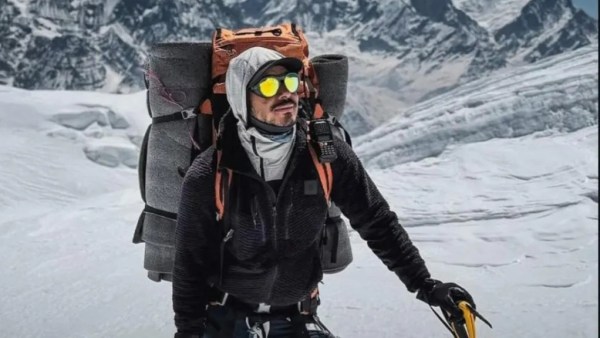 Nirmal Purja at the summit of Mount Everest. (Photo: Instagram/@nimsdai)
Chin, a 48-year-old anaesthesiologist based in Singapore, had reached the top of the 8,091-metre Annapurna with more than 30 other climbers but failed to return to the nearest camp, situated one kilometre below the peak, with the rest of his group, AFP had reported. His strength gave out on the descent and he ran out of oxygen. His sherpa, Nima Tshering, handed Chin the last of his own oxygen and staggered down to raise the alarm, frostbitten and injured himself.
Story continues below this ad
What followed first was not a rescue but a wait. For more than a day, Chin’s expedition organisers and his American evacuation company argued over authorisation while he sat alone in the snow at roughly 7,500 metres, with no tent, no oxygen and no water in the sub-zero cold. Purja went public in frustration, posting: “Chin Wui Kin is still alive… LETS SAVE LIFE.” It was ultimately Chin’s wife, calling from Singapore, who paid a helicopter company directly to fly the search. Pilot Bibek Khadka took his machine above its safe operating ceiling and spotted Chin in the snow, waving.
A race against time on Annapurna
Purja and three teammates, Mingma David Sherpa, Gelje Sherpa and Gesman Tamang, were flown to Camp 3 dangling from a longline beneath the helicopter, the only way to reach that altitude. From there, they climbed at extraordinary speed. “We got dropped into Camp 3 via long line. From there, normally the timing to where he was was more than 16 hours. We did that in four hours,” Purja told National Geographic.
THE MISSION SHIFTS. THE COMPASS HOLDS.
This was never the plan. Initially, the plan was to climb just G2. But just before setting off for Pakistan, I ran the numbers on my 8000m summits. That’s when it hit me: if I tick off Broad Peak whilst I’m here , only one remains “Cho… pic.twitter.com/rovJzFcazP
— Nirmal Purja MBE (@nimsdai) July 27, 2026
Purja’s team found Chin severely dehydrated, exhausted, and frostbitten after more than 40 hours in the open, two nights on one of the world’s most treacherous mountains, where roughly one climber dies for every three who summit.
Through the night, the team lowered Chin by sled to a lower camp in a perilous operation. The next morning, battling high winds that forced him back repeatedly, Khadka finally lifted Chin off the mountain and he was airlifted to a hospital in Kathmandu. The pilot later called it “one of the most difficult long line rescues I had conducted ever”.
Story continues below this ad
.
Global Desk · Remembering Nims Purja
43 hours on Annapurna
In April 2019, days into his record run, Nims Purja turned around to help a stranger stranded above 7,500 metres. The climb up took a fraction of the time he had been left waiting.
.
.
.
.
.
8,091 m · Summit
7,500 m · Chin stranded
7,100 m · Camp 4
6,500 m · Camp 3
4,130 m · Base Camp
.
.
.
Stranded: 40+ hrstwo nights in the open
1
2
3
4
5
~18 hrs
a normal summit push from Camp 3 to the top, days earlier
~4–5 hrs
the rescue climb up to Chin at 7,500 m — on almost no sleep
Routes and conditions differed between the two climbs; durations are approximate.
The 43 hours, pin by pin
1
Summit, 3:50 pm, Apr 23 — Chin tops out with 30+ climbers, dangerously late.
2
Stranded at ~7,500 m — out of oxygen on the descent; his sherpa gives up his own and goes for help. He waits more than 40 hours.
3
Longline drop at Camp 3 (6,500 m) — too high to land; four climbers are lowered in beneath the helicopter. ↑ they climb from here.
4
Reached, 5:30 pm, Apr 25 — Purja, Mingma David Sherpa, Gelje Sherpa and Gesman Tamang reach Chin and lower him by sled through the night.
5
Airlift, 11 am, Apr 26 — after seven helicopter sorties in high winds, Chin is lifted off the mountain to Kathmandu.
Dr Chin Wui Kin, 48, died in hospital in Singapore on May 2, 2019. Nims Purja was killed in an avalanche on Broad Peak on Aug 1, 2026.
Sources: Alan Arnette · ExplorersWeb · AccuWeather · Malay Mail · Kathmandu Post · Purja’s own posts (April 2019). A historical rescue account; some figures vary slightly by source.
.
‘Can I have hot water?’
When the rescuers reached him, Chin was conscious, raising his hand. Moments later he passed out, but not before speaking his only words to Purja and the team: “Can I have hot water?”
Doctors in Kathmandu found his heart rate and body temperature dangerously low, with severe hypothermia and frostbite on his hands and feet. He was flown by air ambulance to Singapore, where his wife waited. Chin succumbed to his injuries a few days later, on May 2, 2019.
Annapurna was not the last time Purja abandoned a summit push to save lives that season. Weeks later on Kanchenjunga, he and his team came across two Indian climbers from West Bengal, Biplab Baidya and Kuntal Karar, stranded out of oxygen high on the mountain. Purja gave Karar his own oxygen cylinder and spent hours trying to bring the men down, radioing repeatedly for backup that never came. Both climbers died, a failure that visibly haunted him.
“The biggest thing for the project so far has been the rescues… Rescuing people from 8,450 meters is way harder than climbing a mountain,” Purja told National Geographic at Everest Base Camp that May, referring to the Kanchenjunga operation.
Story continues below this ad
From Gurkha roots to elite special forces
Purja, 43, who was born into a family of Gurkhas, joined the world-famous group of Nepali soldiers at the age of 18, and thereafter joined the UK Special Forces aged 24, becoming the first Gurkha to pass selection for the elite Special Boat Service. It was during his 16 years in the British military that he developed his affinity for mountaineering.
He gave up his job, his pension and his house to fund Project Possible. The records came, and were eventually broken by others. But as tributes poured in this weekend from Kathmandu to London, it was the rescues that climbers kept returning to: the sleepless dash back up Annapurna, the oxygen handed over on Kanchenjunga.
He never called any of it a sacrifice. Saving a life, he insisted, always came before the record.
