






Gen Z turning against Meloni? Why young Italians are unhappy ahead of 2027


Italian Prime Minister Giorgia Meloni is facing a growing challenge ahead of the 2027 national election — younger voters are increasingly turning away from her government. Her right-wing coalition has less than 30 per cent support among voters under 35, compared with almost 50 per cent for the centre-left opposition, news agency Reuters reported, citing Youtrend polling.
The figures have put Italy’s younger electorate, including Gen Z voters, in focus ahead of what is expected to be a closely fought election.
“Younger voters are clearly leaning towards the centre-left,” Lorenzo Pregliasco, head of the Youtrend polling agency, told Reuters.
The youth vote could prove decisive if younger Italians turn out in larger numbers than they traditionally have.
Why are young Italians unhappy with Meloni?
Analysts link the growing dissatisfaction among younger voters to a lack of economic reforms aimed at improving their opportunities.
Since taking office in 2022, Meloni has done little on the economic front to address some of the problems facing young people, analysts told Reuters. Lorenzo De Sio, a political science professor at Rome’s Luiss University, said the government’s lack of significant economic reforms was a key reason for young people’s hostility towards it.
Story continues below this ad
 Young demonstrators show a banner depicting Italy’s Prime Minister Giorgia Meloni wearing a military helmet, covered in red handprints, during the “No-Meloni day” rally in Rome, November 14, 2025. (REUTERS)
“That is fine if you benefit from the status quo, but very bad for those least protected by it, which often means young people,” he said.
Italy has the lowest employment rate among people aged 15 to 24 in the 21-member euro zone, according to Eurostat data cited by Reuters. The country also spends less on education than almost all its euro-zone partners.
The wage gap is another concern. A young graduate in Germany earns, on average, about 80 per cent more than a comparable Italian graduate, according to the Bank of Italy.
Italy is also losing young graduates to other countries. The Bank of Italy has said more than 100,000 young graduates left the country between 2020 and 2024.
Story continues below this ad
These concerns are reflected in Meloni’s approval figures. Only 25 per cent of voters under 35 approve of her government, compared with 35 per cent among the population as a whole, according to Youtrend.
.
World · Europe · Analysis
Meloni’s poll challenge
Giorgia Meloni’s coalition is strong in the polls overall — but among Italians under 35 it is falling behind, a gap analysts say could matter in 2027.
1 · The under-35 vote
25%
of under-35s approve of the government — against 35% of the population overall.
2 · Why young Italians are unhappy
Jobs & opportunities
Little economic gain for the young
Education
Spending cuts
Lower wages
Weak pay prospects
Migration & security
Law-and-order measures
Reasons cited by analysts and reflected in polling — not an exhaustive or ranked list.
3 · Where are young voters going?
Young Italians (under 35)
.
Turning away from Meloni’s coalition
It isn’t a simple left-vs-right story — they scatter three ways
↙
Centre-left
Their main destination
↓
Far right
Vannacci’s National Future draws some
↘
Stay home
Abstention, historically high
4 · The 2027 question
National election · 2027
Could young voters decide the election?
2023
Masked
Youth disaffection was hidden by low turnout — many simply didn’t vote
2026 referendum
67%
Under-35 turnout — a sign of what youth mobilisation can do
If young Italians turn out in large numbers in 2027, analysts say, they could be decisive in a race that looks neck-and-neck.
Sources: Reuters · Youtrend polling (Lorenzo Pregliasco) · Lorenzo De Sio, Luiss University. Figures are polling estimates; the 2027 outcome is an analysts’ projection, not a certainty.
.
The shift is even sharper when compared with 2023. Meloni’s Brothers of Italy party alone then enjoyed roughly the same level of support among young voters as her entire three-party coalition does now, according to Youtrend polling cited by Reuters.
Young Italian men and women are split
The political divide among younger Italians is also shaped by gender, a pattern seen in several other European countries.
Young men are more inclined to support right-wing parties, while young women are more likely to back the left, according to a Bocconi University study based on polling data from SWG.
Story continues below this ad
Brothers of Italy had the support of 15 per cent of men aged 18 to 29, compared with just 4.2 per cent of women in the same age group.
The pattern was reversed for the 5-Star Movement, which was backed by 18 per cent of women under 30 but only 5.1 per cent of men.
The figures suggest that the decline in Meloni’s support among younger voters should not be read as a uniform political shift.
Where are younger voters moving?
Much of the support lost by Meloni’s coalition is moving towards the centre-left opposition, but the picture is more complicated than a simple leftward shift.
Story continues below this ad
Meloni is also facing competition from the far right for voters dissatisfied with her government.
National Future, a far-right opposition party formed in February by former army general Roberto Vannacci, is polling at around 7 per cent, according to Reuters.
Its strongest support comes from middle-aged men, but it has also attracted some anti-immigrant urban younger voters with Vannacci’s pledge to return thousands of migrants to their countries of origin.
“Vannacci is certainly holding up better with young voters than the ruling parties are,” Pregliasco said.
Story continues below this ad
That means a decline in support for Meloni does not automatically translate into a surge for the centre-left.
Why Meloni’s security policies have angered some young people
Meloni’s law-and-order agenda has also brought younger Italians into conflict with the government. Her administration has introduced measures targeting rave parties, the production of so-called “light” cannabis, disruptive street protests, squatting and juvenile crime.
The government has defended its security policies as an effort to strengthen public order and tackle crime. Critics, however, argue that some of the measures disproportionately affect younger people.
In November last year, thousands of students took part in a nationwide protest dubbed “No Meloni Day”. Demonstrators opposed the government’s security decrees and education spending cuts, as well as Meloni’s support for Israel over the Gaza war.
Story continues below this ad
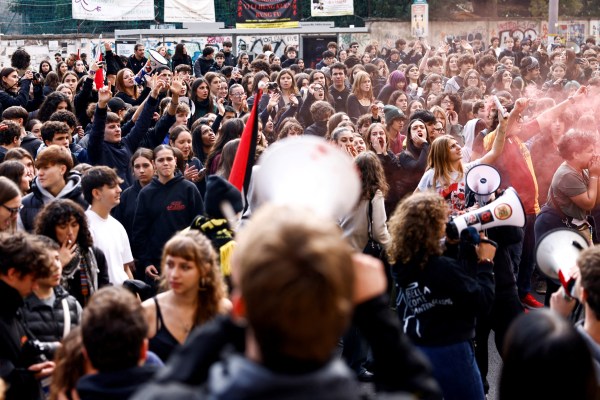 Young demonstrators protest against Italy’s Prime Minister Giorgia Meloni on the occasion of a “No-Meloni day” rally in Rome, Italy, November 14, 2025. (REUTERS)
The government last month also introduced a bill seeking to change the rules governing the criminal responsibility of minors. Under the proposal, those aged between 14 and 17 who commit crimes would be considered fully responsible unless proven otherwise.
That would reverse the existing system, under which a judge must establish that a minor understood the implications of their actions.
Antigone, a prisoners’ rights organisation, has said Italy’s juvenile prison population rose by 50 per cent following a 2023 decree that strengthened penalties for minors.
The government has also tightened rules around sex education in schools, with teenagers requiring written parental consent under the measure.
Story continues below this ad
A referendum showed young voters can make a difference
For years, low turnout among younger Italians has made their dissatisfaction less visible at the ballot box. Many voters under 35 have tended to stay away rather than express their opposition to the government through voting.
The March referendum on a justice-system reform backed by Meloni provided a different picture.
Around 67 per cent of voters under 35 turned out, according to data cited by Reuters, and 60 per cent of them rejected the reform. Overall turnout was 59 per cent, with 54 per cent voting against it.
Days before the referendum, Meloni appeared on a podcast hosted by a popular rapper to reach younger voters.
“The referendum showed what impact the young can have if they vote en masse,” De Sio said. “At the next election they could be decisive.”
(With inputs from Reuters)
