





4 min readNew DelhiAug 23, 2026 07:43 PM IST
“The new generation just plays a totally different kind of chess. I was watching this game, and I had absolutely no clue what was happening.”
Those were the words of American Grandmaster Wesley So, struggling to make sense of the first Classical semifinal game between R Praggnanandhaa and Vincent Keymer of the Grand Chess Tour (GCT).
So was left perplexed by the wacky choices the younger generation – in this case, the two 21-year-olds – seemed eager to make. The American, fresh off his big win at the 2026 Sinquefield Cup, admitted he failed to understand the position in the Pragg vs Keymer contest. But what amazed him most was Praggnanandhaa’s ability to thrive in weird and complex positions.
“Pragg seems very comfortable; he has got everything under control. He is like, ‘I know what I am doing!’ And I am like, ‘what is this position?’ I believe Pragg just feels very much at home in these kinds of insane positions!” So exclaimed after drawing his own game against Fabiano Caruana.
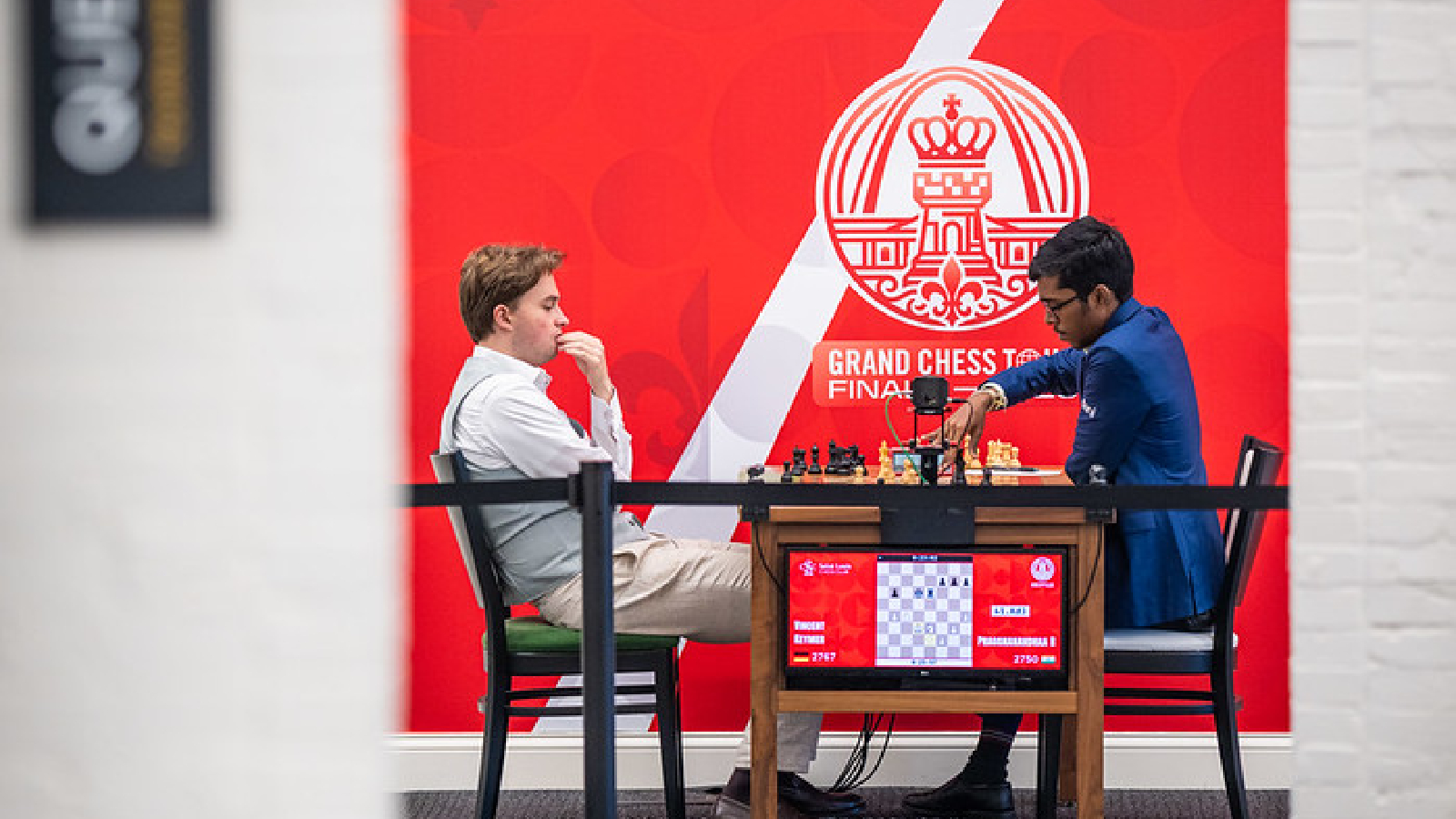 R Praggnanandhaa takes on Vincent Keymer in first semifinal of Grand Chess Tour Finals. (FIDE/Lennart Ootes)
Keymer, however, proved to be a worthy match for Praggnanandhaa, holding the Indian to a draw after surviving a massive scare in the middlegame. An engrossing fight for a spot in the summit clash of the 2026 GCT Finals will continue on Day 2.
When Praggnanandhaa deflected his queen to b3 as early as the fourth move, deviating from the opening principle of developing minor pieces, it was clear he came into the clash with the sole purpose of winning. In the Symmetrical Three Knights System of the English Opening, however, it was the German who held a slight positional edge with White.
But Keymer’s 20-minute deep think for his 12th move, the b5 pawn push, gave Praggnanandhaa a half-hour edge on the clock.
Story continues below this ad
In a slow-moving game thereafter, Praggnanandhaa was forced to rely more heavily on the clock for each reply. Soon enough, Keymer got a central break with exd5, a move deemed brilliant by the chess.com engine. Praggnanandhaa had no choice but to go for an all-out attack, and that turned the tide in his favour. He went for quick trades and found himself in a sharp position with material imbalance. With time running low for both, Praggnanandhaa had a better combination of a rook and bishop against Keymer, who had a bishop and a knight with an extra pawn.
It was an opportunity to forge ahead and take a strong lead. But his decision to trade bishop while retreating his rook back allowed Keymer to get back into the contest. The game dragged on and eventually ended with no pieces left on the board, the Indian forced to share the spoils.
So, who had defeated Praggnanandhaa for his third Sinquefield title, was still impressed by the Indian’s relentless approach.
 R Praggnanandhaa takes on Vincent Keymer in first semifinal of Grand Chess Tour Finals. (FIDE/Lennart Ootes)
“Pragg wants to play for a win with black, with white, and then with black again. Normally in a match, you play solidly with black and play to win with white, but with Pragg… Black, green, or white, he plays for a win!” So said.
The 2026 Grand Chess Tour Finals, featuring a $450,000 prize pool, sees Caruana, So, Keymer, and Praggnanandhaa competing in a single-elimination knockout. Each match consists of eight games across three time controls: two classical (6 points for a win, 3 for a draw), two rapid (4 points for a win, 2 for a draw), and four blitz (2 points for a win, 1 for a draw). The winner takes home the title and a $200,000 prize.
Story continues below this ad
In its 11th edition, Praggnanandhaa is chasing a title no Indian has ever won. Magnus Carlsen, Alireza Firouzja, Caruana and So have each won it twice, while Hikaru Nakamura and former world champion Ding Liren have lifted it once.
