

‘Fully prepared’: Iran threatens tit-for-tat move with oil chokehold as US widens economic sanctions

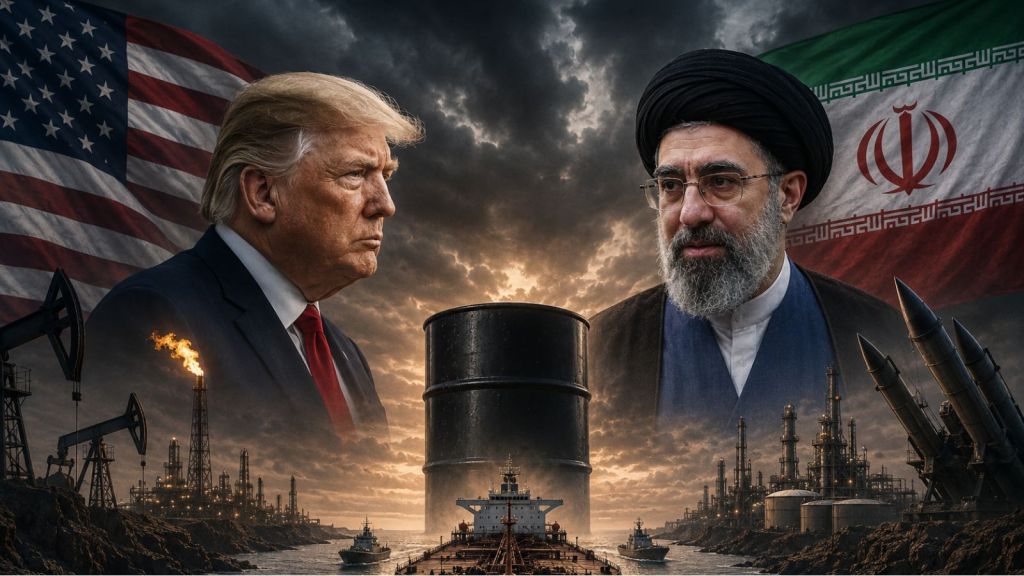
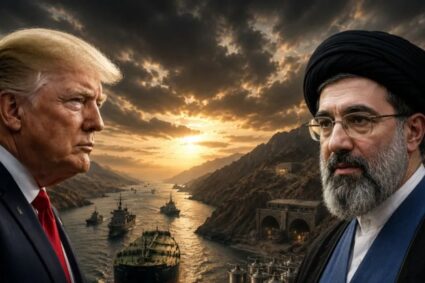
 US President Donald Trump and Iran Supreme leader Mojtaba Khamenei. (Photo: AI-generated)
 Iran on Tuesday threatened to hit back against an expanded round of US economic sanctions, with senior officials in Tehran voicing confidence that key trading partners would not fall in line with Washington’s pressure campaign. The warning came a day after US Treasury Secretary Scott Bessent unveiled new sanctions aimed at cutting off Iran’s economic lifeline and pressuring Tehran to end the war. Oil prices, however, showed limited immediate reaction, even as shipping through the Strait of Hormuz slowed sharply.
Why did the US widen sanctions on Iran?
Treasury Secretary Scott Bessent announced the new sanctions, describing them as an effort to cut off Tehran’s economic lifeline and pressure Iran to end the war. He warned that countries continuing to do business with Iran could face secondary sanctions and exclusion from the dollar-based financial system, although Washington stopped short of imposing those penalties immediately.
The new measures target 60 individuals, entities and vessels linked to Iran. Bessent did not identify which trading partners could face secondary sanctions or say when penalties would take effect, saying countries would be given time to comply. The list notably left out major Chinese financial institutions involved in Iran’s oil trade, even though China remains Iran’s biggest oil buyer.
How has Iran’s leadership responded?
Iran’s leadership quickly dismissed the new measures, with officials portraying the sanctions as evidence that Washington was struggling to achieve its objectives.
- Parliament Speaker Mohammad Bagher Ghalibaf dismissed the sanctions on social media, arguing Washington isn’t in a strong enough economic position to further isolate itself from other countries.
- Ghalibaf claimed Iran’s trading partners had privately signalled they wouldn’t take the US measures seriously.
- Economy Minister Ali Madanizadeh struck a defiant tone on state television, saying Tehran was “fully prepared for the US sanctions” and warning the country’s response would no longer be purely defensive.
- Madanizadeh added that neither China nor Russia had accepted the US measures, predicting other nations would resist them too.
Is Iran threatening military action too?
Alongside the economic pushback, Tehran has also raised the prospect of a harder response. Brigadier General Hossein Mohebbi, an Islamic Revolutionary Guard Corps representative, warned of military retaliation against US interests and energy chokepoints if Iran’s infrastructure is threatened, according to Iranian state media.
Story continues below this ad
Iran has also tightened pressure on shipping through the Strait of Hormuz. Tehran has blacklisted 45 tankers it says violated its rules for crossing the waterway, warning that the vessels could face fines, detention and cargo confiscation.
Why is a US senator questioning the sanctions?
Not everyone in Washington believes the new sanctions will change the course of the conflict. Democratic Senator Chris Murphy has argued that Iran has gained the upper hand, saying, “Iran is winning the war. Trump is losing.”
Iran has also tightened pressure on shipping through the Strait of Hormuz. Tehran has blacklisted 45 tankers it says violated its rules for crossing the waterway, warning that the vessels could face fines, detention and cargo confiscation.
- Murphy argued that Iran did not control the Strait of Hormuz before the war but does now.
- He noted Tehran still holds 30 of its original 33 missile sites along the waterway, despite months of US strikes.
- He argued the US has already sanctioned nearly everything it can, leaving little room for this round to shift Iran’s position.
Are there fresh risks to oil supply?
Tensions at sea remain high, and supply pressures are mounting in the background.
Story continues below this ad
- An oil tanker was struck and disabled by an unidentified projectile near Oman on Tuesday.
- The US Strategic Petroleum Reserve has fallen to its lowest level since November 1982.
- Before the war began, the Strait of Hormuz typically carried cargoes equal to about 20% of global oil use a flow now under growing strain.
How are oil markets reacting?
Brent crude edged up 0.3 per cent to $92.44 a barrel, while US WTI crude rose 0.4 per cent to $85.38, recovering slightly after both benchmarks fell more than 2 per cent in the previous session, according to Reuters.
Commodity strategists at ING said traders are treating Washington’s push to isolate Iran’s trading partners as a marginal development rather than something likely to shake markets, while KCM analyst Tim Waterer offered a note of caution, pointing out that Iran still retains the ability to respond by disrupting shipping.
