

Satellite images show scale of destruction in Nepal


3 min readUpdated: Aug 27, 2026 11:02 AM IST
A massive flash flood in Nepal on Wednesday washed away villages in the northern part of the country, leaving at least 165 people dead and a trail of destruction. About a 1,500 more are still missing in Nepal and Tibet as the deluge in the Bhote Koshi river, originating from Tibet, engulfed many areas in Rasuwa, Nuwakot, and Dhading districts.
The Planet Labs satellite images, shared by Nepal’s National Disaster Risk Reduction and Management Authority, captured the extent of devastation in various regions of northern Nepal, showing entire regions wiped away by the current.
Planet Labs को स्याटेलाइट तस्बिरको विश्लेषणका आधारमा गरिएको प्रारम्भिक अध्ययनबाट नेपाल-चीन रसुवागढी नाकाबाट करिब २० किलोमिटर उत्तरपूर्व नेपाल-चीन सिमानामा गएको हिम-चट्टान पहिरोका कारण ल्हेन्दे खोलामा गेग्य्रानसहितको बाढी आएको देखिएको छ। pic.twitter.com/kCAo9O1Zb0
— NDRRMA (@NDRRMA_Nepal) August 26, 2026
Reports from the affected areas and the National Disaster Risk Reduction and Management Authority said the swollen Bhote Koshi river swept many settlements across the 60-km road from Xylong in Tibet, China, down to Rasuwa, Nuwakot (Trishuli), and Dhading. The river joins the Trishuli River in Rasuwa.
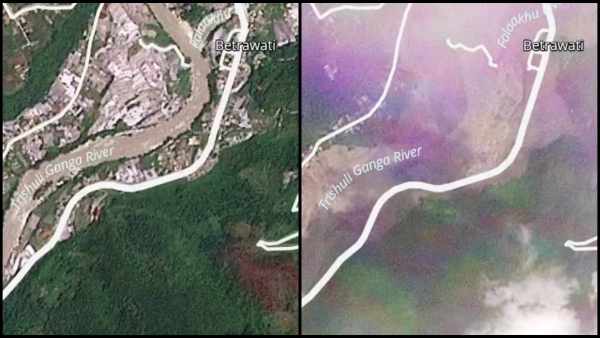 Before (left) and after images of Betrawati area of Nepal. (Photo: PBSLabs via NDRRMA)
The flood severely affected Timure and Syapru Besi in Rasuwa district, with villages, market areas and infrastructure projects damaged or washed away. Authorities have warned residents along the Bhote Koshi and Trishuli rivers to move to safer ground as floodwaters move downstream.
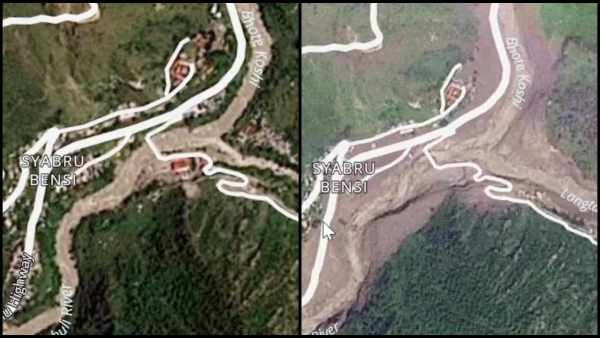 Before (left) and after images of Syapru Besi area of Nepal. (Photo: PBSLabs via NDRRMA)
The NDRMA stated that the images from Planet Labs were obtained with the support of the Stimson Centre. The images were from the Devighat area, Betrawati area, Hakubesi area, and Syaphrubesi area.
Scientists from the International Centre for Integrated Mountain Development (ICIMOD), along with partner institutions in Nepal and China, are investigating whether an ice-rock avalanche from a high-altitude area could have triggered the flash flood and mudslide on the Nepal-Tibet border. ICIMOD is a Nepal-based intergovernmental institution leading the global effort to protect the Hindu Kush Himalaya (HKH) region.
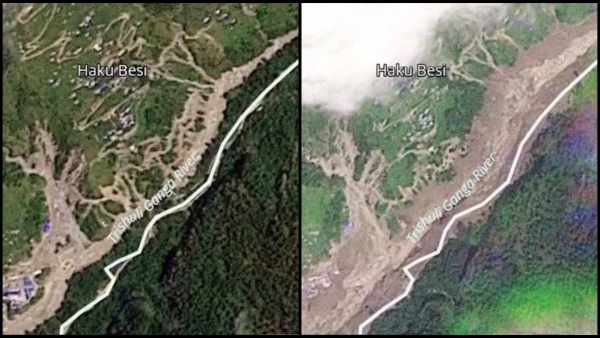 Before (left) and after images of Haku Besi area of Nepal. (Photo: PBSLabs via NDRRMA)
“Preliminary assessment based on video footage and information from affected areas suggests that a large volume of ice and rock debris may have entered the Lende Khola, a tributary of the Bhote Koshi river. Researchers say the event could have generated a sudden surge that carried water, sediment and large boulders downstream,” ICIMOD said in a press release.
Stay updated with the latest – Click here to follow us on Instagram
