






Express in Nepal | Houses buried in mud, fields, orchards destroyed: ‘We have nothing left now’


Until Wednesday morning, ‘1 Number Pul’ was a quiet, idyllic hamlet located in the valley area of Nepal’s Nuwakot district, on the banks of the Bhotekoshi river. Today, the area, like many others in the region, lies submerged in mud and debris.
Only seven houses are left standing, and three of these are buried in mud right up to their second floor. The rice and maize fields are gone, as are the banana and apple orchards. Mangled banana plants lie on a rooftop, while the bare trunk and branches of a mango tree stand covered in mud.
The hamlet gets its name from a bridge that runs across the river — part of the Trishuli hydroelectric project in the area. The project, commissioned about six decades ago, was among the first jointly developed by India and Nepal.
The floodgates of the dams along the river, the bridge from which the hamlet derived its name, and the three-lane highway that led to the border district of Rasuwa are barely visible, all buried under the sludge of mud and debris.
Dwarka Nath Pyakuryal, 60, a resident of the area, recalls that he had just sat down for breakfast on Wednesday morning when the flash floods hit the area. He was on the third floor of his house, just about 30 metres from the riverbank and about 500 metres downstream from the floodgates of the Trishuli hydel project.
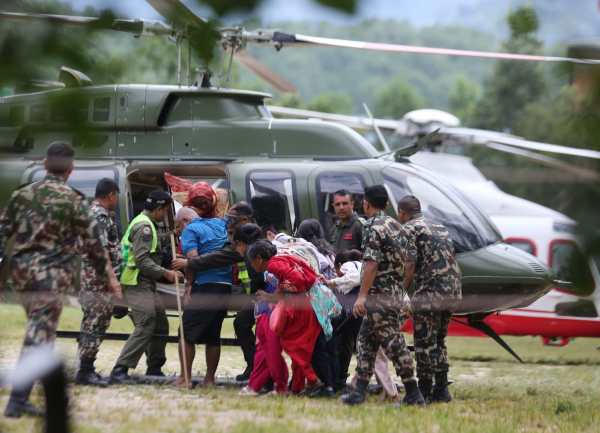 Today at the army base where a rescue and relief command centre is based, scores of school children were among those who were rescued from the adjoining regions cutaway after the floods. (Express Photo by Tashi Tobgyal)
He says he first heard a loud noise. “I got up and looked outside the window. I had never seen such a sight — a wall of what appeared to be black water was rushing down,” he says.
Pyakuryal says he screamed for his family to rush out and run up the valley. While seven of them survived, his eldest daughter-in-law did not make it to safety. In just a few minutes, he says, the flood waters swallowed the fields where his family had grown rice and maize for generations, their banana and mango orchards, poultry and a tractor.
Story continues below this ad
On Saturday, when Pyakuryal and his wife made their way down the hills to their house, all that they could salvage was a few clothes, all covered in mud.
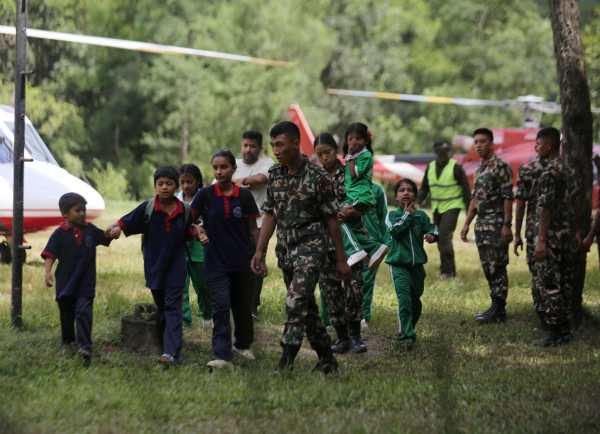 Security personnel send out loud warnings on an impending second flood, after reports of a second lake break in the higher regions. (Express Photo by Tashi Tobgyal)
“I have seen the river overflow many times. Just last year, half our paddy crop got submerged. But never have I seen such a flood, nor have I heard my parents or grandparents recalling such a thing,” he says.
“We have nothing left now, just the clothes we were wearing and these clothes we took today,” he says.
An eerie silence has settled over the area, which earlier had about 19 houses with a population of about 150 people, a temple, a cooperative bank branch, a grocery store, and a funeral home. Most of its residents have now left for higher ground.
Story continues below this ad
Pyakuryal’s cousin, Sita, is among the few in the area on Saturday. As she looks at the spot where her house once stood, she can’t help but cry. “I just had to come down and take a look,” says Sita, who lost a daughter-in-law and granddaughter in the flood.
Pyakuryal, however, is already planning ahead. “There is no other way I can live my life. If I keep thinking about that day, I won’t be able to survive,” he says, as he plays with Khaire, the local dog who has also survived.
On the third floor of his house, the breakfast that he left behind on Wednesday — rice, dal and some vegetables — still lies there.


Stay updated with the latest – Click here to follow us on Instagram
