

‘I need their bodies for last rites’: Heartbreaking search for families after Nepal floods


6 min readBetrawatiUpdated: Aug 31, 2026 08:51 AM IST
Over the last four days, Lekhnath Adhikari, 43, has travelled hundreds of kilometres on his uncle’s bike. He has been going to almost every search and relief camp, hospital and locality near his native village Betrawati, and areas downstream.
Betrawati is located in Nuwakot district, north of Kathmandu. It is on the border of Rasuwa district – which was the epicenter of the flash floods.
While it usually takes two hours to reach the village, after the floods, it takes roughly four hours. On Wednesday, when the flash floods on Bhotekoshi river hit his village, his wife, son and daughter were able to run to higher ground to escape the raging waters, but his elderly parents were not.
Five days after the devastating floods, thousands of Nepalese security personnel remain neck-deep in search and rescue missions. There is also a parallel effort – mounted by the family members of those missing. Thousands like Adhikari have set out on desperate search missions of their own as they scour the steep Himalayan valleys and the scores of villages dotting them for some sign of their family members, either dead or alive.
A few days ago, there was some discussion among his neighbours of three bodies being discovered on the roof of a building in the village. Adhikari’s hopes had risen and he had made his way to the spot as quickly as he could, on bike and on foot through the forest, but they were not his parents.
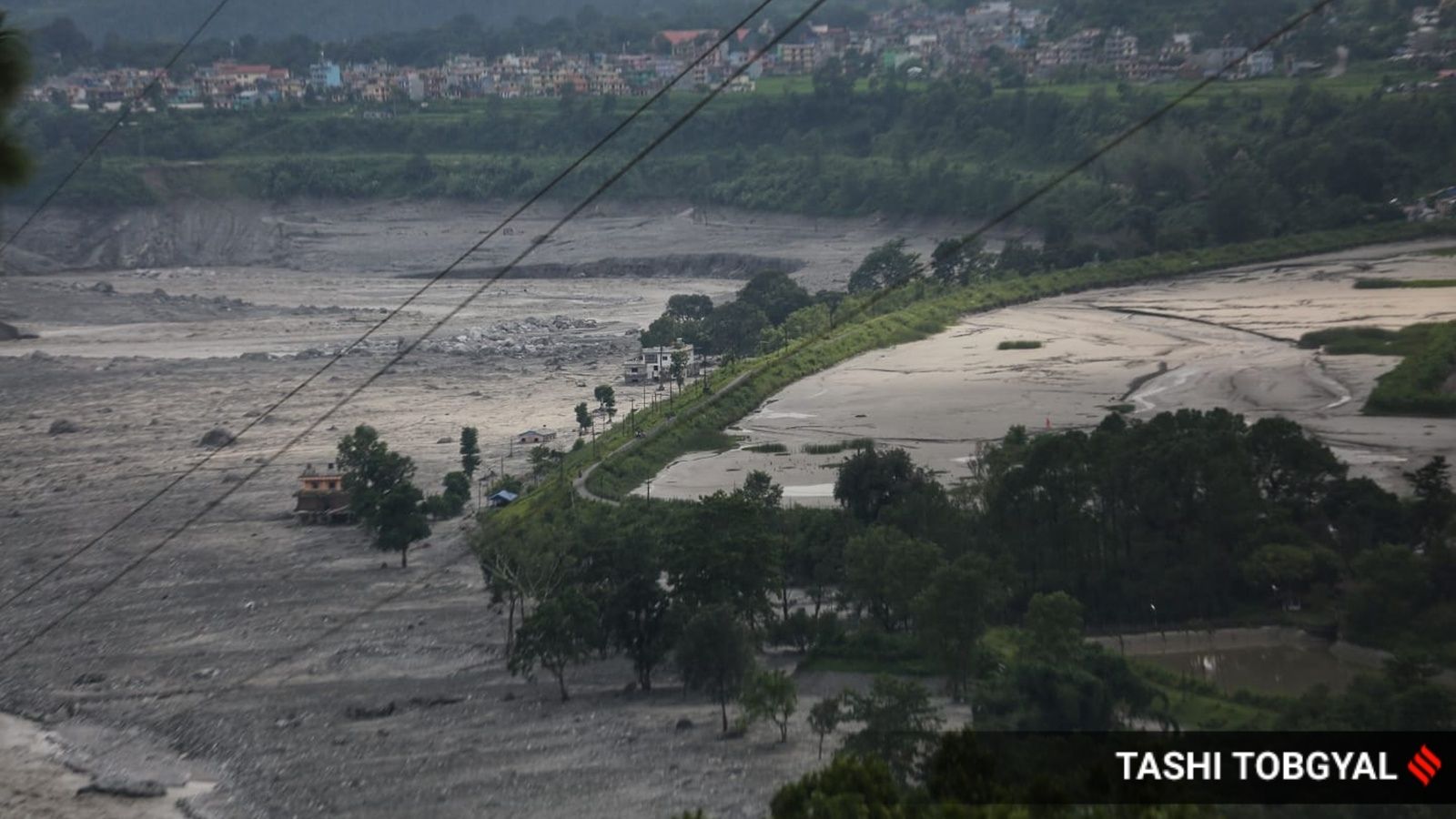 The Trishuli Hydro Power station lies in a destructed state and invisible in the photo ( photo shows the spot of the water way and the headgate) after the flash floods. (Express Photo by Tashi Tobgyal)
“I just want to find their bodies so that I can start their last rites and give them a peaceful send-off from this world,” said a red-eyed Adhikari, sitting inside the Suryagarhi Relief Camp. He has sent his wife and children to Kathmandu to stay with some relatives. “But I can’t stop looking, at least not so soon… I will keep looking for another two weeks, and then start the final rites if I can’t find them by then,” he said.
Navin Tamang, 35, knows that he is smelling foul – with the valley acting like an induction cooker, trapping intense heat and humidity within its forests and temperatures reaching 35 degrees Celsius. “It has been so long… I know I will not be able to find my wife and two daughters now, but I can’t stop myself. A small part of me still thinks they might be alive, trapped somewhere,” said Tamang, who was working in Malaysia when the flooding happened.
Story continues below this ad
With a bag of bare essentials on his shoulder, and a walking stick in his hand, 35-year-old Tashbir Tamang has been climbing up steep mountain sides, village after village, hoping that somewhere he will find his sister – 28-year old Rashmi Tamang and her daughters Monica and Manisha.
“I had heard from some neighbours that they might have escaped the flood. So, I have been to every camp, got their details noted down in Army registers, searched the rescued lists and yet there is no trace of them,” Tashbir, who has looked through every square km of forest above Betrawati, said. His legs are caked in mud because he jumps into the debris every time a body is found, hoping… dreading.
There are others who seem to have come to terms with the demise of their loved ones, even if they were not able to find their bodies. At Bhainsi Bazar in Umerkot, brothers Vasudev and Arjun Pyakurial began performing the last rites for their mother after failing to trace her. Vasudev, who was holding her hand while they were rushing to escape the flood, had lost his grip. The torrent consumed her within seconds. After three days of frantic search, the brothers finally came to terms with the crushing reality.
In the midst of a lush harvest of corn, under an old Sal tree towards the western corner of the fields, the brothers built a ‘Kriya Kuti’, a sacred and secluded ground for the mourners during the traditional 13-day ‘Antyesti’. An effigy of their mother, made from the sacred ‘Kush’ grass, is offered food and prayers daily. The brothers, covered in a piece of white longcloth, indulge in conversations on karma, life and grief while holding nothing and no one responsible for the tragedy that has befallen them.
Story continues below this ad
Meanwhile, time stands still in Betrawati. While most of the buildings were washed away, the clock tower still stands. The hands of the clock are stuck at 9.30 am.


Stay updated with the latest – Click here to follow us on Instagram
