

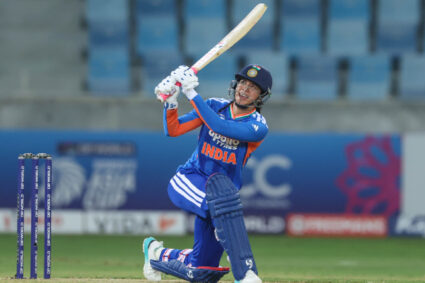
From training under a tin roof to churning out champion lifters, coach Sharma carries weight on his shoulders

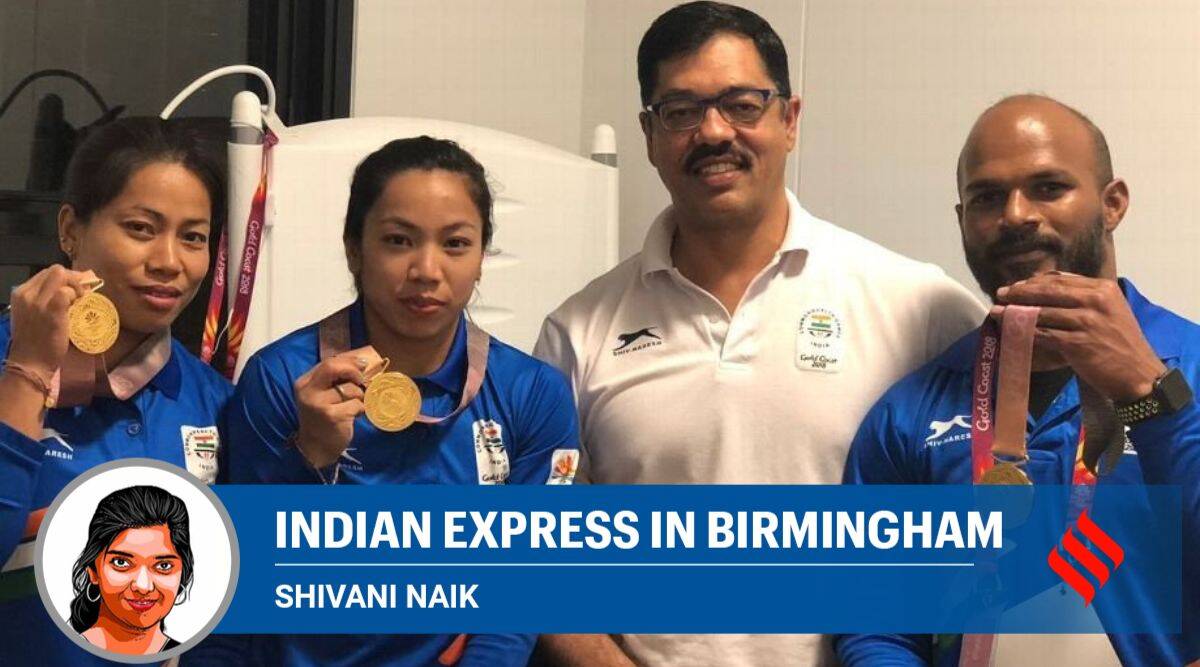
Those are the best kind of promises – the ones meant to be broken that very instant after they are made.
Coach Vijay Sharma, who steered weightlifter Mirabai Chanu to Olympic silver, and heads and guides India’s training program in the sport over the last decade, recalls one promise made to his family exactly a year ago.
“I thought I’d get time to go on a family vacation after the Olympics and had promised them, though I doubted I’d actually keep it. I’m just not finding time away from camps. That will be the only regret of my life – that I couldn’t give any time to my family. I just wasn’t around to watch my children grow up,” he says with a wry smile.
The Commonwealth Games fetched up in no time, within a year of the Tokyo Games where a lifetime dream of an Olympic medal for his charge was fulfilled. Sharma’s meticulous preparations – always backdating to months, meant even 12 months since the historic silver, the family remained a firm second priority.
“Family keeps complaining. I wasn’t around for my kid’s 12th boards, and no vacations since I’m obsessed with the sport and always occupied in that. But you have to understand one thing in this sport – aadmi struggle karke hi medal jeetega. Weightlifting medal jeetna paisewaalon ka kaam hai hi nahi,” Sharma asserts. (Only intense struggle breeds hunger that brings medals. Winning in weightlifting is not a rich person’s domain).
Sharma is unwavering in his philosophy of which social strata aces his chosen sport, and where champions will emerge from, despite the surfeit of fancy fitness gyms where the urban folk in latest athleisure pump ridiculous weights on state-of-the-art equipment, and gulp down flavoured protein shakes. “Zaroorat wala aadmi hi dum lagaayega,” he adds of lifts that total at times four times the athlete’s body weight. Only the needy will give their all.
His father left their native Akhnoor sector pastoral home in Jammu after serving in the army for 16 years, coming down to the plains in Modinagar, UP, from the pretty Himalayan foothills, for livelihood. “You can’t farm in the hills there. Empty stomachs force such decisions,” he laughs, “everyone from that village would join either CRPF or BSF. But after his 16 years, the family still had nothing. So, we moved. Necessity forces you to leave comfort zones.”
A 400m runner in school, Sharma was a late starter in weightlifting himself – taking fancy to the deadlifts in his first year of BCom, watching seniors and getting hooked in 1989. Considerably tall even back then, the 53-year-old didn’t realise that height could be an impediment in his sport when he went to his first inter-University at Guntur, representing Haridwar in 1991. “Padhai mein thoda duffer tha (I was weak in studies),” he explains, and he doubled his efforts to medal in 1992, since the sports certificate could help him pass.
Training under a tin shed
His efforts in 85kg would bring him a senior nationals medal in 1993 and a Railways job, and his first international tour at age 30 in 2000, albeit medalless, made him delirious for just the opportunity to represent India.
“Chhote se kasbe se tha main (I came from a small neighbourhood). I thought everything about the international tour was spectacular,” he says, about being wide-eyed. A campmate of Karnam Malleswari and Kunjarani Devi at Patiala, Sharma got into weightlifting when they trained under a tin shed at Patiala. “Ek chhappar tha bas (There was just one tin roof, that’s it). We never had AC training halls at national camps like now. The diet was abysmal for a strength sport,” he recalls.
Still dizzy with having experienced an international competition, he would retire and start training young children in lifting at a local gymnasium – not so much coach, as tweak minor techniques of youngsters and mentor them. “I wasn’t particularly interested in coaching. But in the next 12 years, a bunch of my UP lifters won at Nationals, and in 2012 I was called for the senior national camp by the federation.”
It was at the 2014 Glasgow Commonwealth Games, in fact, that Vijay Sharma, then in charge of the men’s team, would volunteer to help out the women’s team – including Mirabai Chanu – and coach Hansa, with their warm-up routines.
But it was a written proposal on preparation he’d submitted to the federation and SAI in the leadup to Glasgow that earned him respect from the authorities. “Injeti Srinivas, the SAI DG then was very dynamic and allowed me to set up a kitchen where I could get my team to cook meals for lifters. They needed very high protein, and just chicken has limitations. They allotted me a separate kitchen. I can’t even make tea, but from my experience as an athlete, I knew how deficient in proteins Indian lifters are,” he recalls.
Detailed training programme
He would then submit a detailed training program of loading up and peaking towards the CWG including acclimatising in Scotland and bolstering his support staff. “There was no scene of a physiotherapist with the Indian team till 2014. No one even thought of a psychologist because people think it’s about strength only. Now we have four psychologists working with our lifters. Plus nutritionists,” he says.
Hailing from a small town he might be, but Sharma jokes he carried every shade and aspect of failure in his time as an athlete, gifting him a litany of requirements that his wards could be furnished with, so they wouldn’t suffer.
A sport that created a stir in 2000 with Malleswari’s medal, and was forgotten soon after, had stayed steadfastly archaic in its training methods with nothing changing at Patiala’s national camps.
“There was a lot of resistance to scientific training from senior campers when I started in 2013. But my nature is that I won’t force anyone. I can repeat something 100 times politely to get my point across, and leave it to the athlete – try it in training, if it doesn’t work, we won’t continue. I was also scared if the results will come or not, so there was no ego in ordering them to do this or that. I wasn’t 100 percent confident and was frankly scared. Seven of 10 experiments might work. But three failed,” he recalls.
The diet apart, he would draw up every lifter’s blood profiles, checking for vitamin D and iron deficiencies, and put them on artificial tablets till the markers went up. Resting heart rates and sleep patterns were monitored.
Sharma jokes he carries the image of appearing very scholarly wearing his spectacles, but in reality, has great difficulty reading anything. “Padhai likhai, kitaabon se bohot taqleef hai. Later I would record lectures, hear them 3-4 times, translate them from English, use google and the internet,” he says, sounding very tortured by the exertions involved in updating himself. But his hunger to learn was insatiable and came from a deep love for sports.
“My interest in sport since school was never-ending. I played football, hockey, ran 400m. Imaandaari se pyaar kiya sab sport se, though I was jack of all trades and master of none. But har game mein ghuusne ki aadat thi. I would strike up conversations about each sport with athletes and coaches, and those were my greatest learnings. I became friends with lots of foreign coaches speaking different languages, and we would converse on sport for hours despite not sharing a common language,” he says.
It’s how he picked a shot-putter’s brain for learning new things on recovery and power building. And it was foreign coaches in track & field who helped him figure out ways to deal with adamant trainees.
Overcoming Rio Olympics disappointment
Besides Mirabai’s boundless capacity to work hard, it was a wrist injury she suffered after 2016 that really pushed Sharma to find solutions for every technique glitch in her lifts. Chanu had back issues – muscle imbalance and hip troubles. But it was the rolled wrist around the bar that drew the coach’s biggest empathy. “I suffered from the same thing for 5-6 years and just carried along,” he says.
When she mentioned once about the wrist, he immediately could relate to the shooting pain and knew exactly what was to be done. “I’ve played the game and lifted the bar a 1000 times, so I have full knowledge of the movement. I train with them, to understand which muscle is taking what load. From my experience, I knew what diet Indians habitually lacked in,” he says.
Train! Breathe! Repeat!
Mr. Vijay Sharma, Chief coach women’s #weightlifting team, the man of the hour with 2🥇won in #CWG2018 under his guidance. See the glimpses of coach in action during training. #IndiaAtCWG #GC2018 #SAI pic.twitter.com/Ah2FiPamxl
— SAI Media (@Media_SAI) April 6, 2018
It’s not uncommon if you watch in the wings where coaches stand during competition, for them to literally live out the entire movement – wince with the muscle-contracting concentric as if simulating the lift, widen the eyes during the first hang, or screw the eyes involuntarily during the double-knee bend scoop – with their ward on stage. A split-second comprehension of aches they are going through, then, is expected. Still, it was the visceral experience of Mirabai’s 2016 Olympic disappointment, which tested Sharma.
“The whole world watched us fail. I was disappointed, but my mind stopped working after reading some of the criticism. I knew I couldn’t get her ready for the competition, but I went blank. Those who knew nothing about my sport were saying I’m not even a proper coach and was faaltu and bakwaas. No one saw that it was the same coach who took a lifter from 78 kg in snatch to 87 kg. No one even mentioned I had brought about improvements of 20kg in lifters from previous Games,” he recalls.
The federation though would trust him, after demanding a written debrief of what had gone wrong. “I thought I’d be sacked, but they trusted me and gave me a last chance.” Mirabai would become World Champion in 2017, and validate some of Sharma’s methods.
Compulsive desire to improve
Earlier, impressed with his compulsive desire to improve and learn new techniques, the federation had packed him off to an IOC coach’s scholarship after the 2014 CWG to Budapest. “I had neither diploma nor degree in coaching, so the federation sent me. I had only technical knowledge of the sport, in Hungary, my scientific base was strengthened. I always knew our weaknesses, but this was a chance to find solutions. In Budapest, I learnt a lot of correction methods under advanced instructors,” he says.
Indian lifting until then would get Russian and Bulgarian coaches who would teach uniform techniques to all lifters. “Those were copy-pasted training programs, which were not upgraded for years. What those coaches didn’t realise was that Indian body structures were different from Russian DNA. European bodies mature at 16-17, Indians much later. You needed to look at a lifter, and individually work on their weakness – whether it was thigh, upper body, or in snatch. Foreign coaches applied blanket methods for all kids. Each child is different,” he says.
The 2016 failure though, pushed him to further scour the deep for enhanced knowledge, and it’s how he found out about American physiotherapist Aaron Horschig. “Apna physio ka maamla halkaa tha (we were lacking in physio). When we returned and she had another bad injury in 2018, I searched social media and got talking with Dr. Aaron after following his Youtube videos for a few years.” A personal consult was needed, and Sharma would travel to the US to meet the master brain.
A cricket lover, who was influenced by Kapils Devils and the dashing Krishnamachari Srikanth, Mirabai’s 2021 Tokyo medal fuelled a dream of producing more champions.
“In the absence of shooting, the mantle falls on weightlifting to win most medals. We will look to win more than last time, 11-12 at least,” he says of the next few days. “For Mira, the target here is to improve her Snatch which is weaker (and kept her adrift of gold at Tokyo) before qualification begins this December. At the CWG, the men are very good and will give a good fight.”
Subscriber Only Stories
It’ll be time to make a promise of a family vacation once more. This time, he intends to keep it.
