

Iran claims it ‘damaged’ E-3 Sentry AWACS in major blow to US air superiority in Gulf | Why this matters


An American E-3 Sentry AWACS was destroyed in an Iranian missile barrage on Saudi Arabia’s Prince Sultan Air Base on Saturday, which left more than a dozen US personnel wounded, Tehran’s state-owned Press TV reported. Visuals of the aircraft and debris have surfaced on social media.
The Sentry, carrying the serial number 81-0005, was among several aircraft housed at the base. Iran fired six ballistic missiles and 29 drones at the facility, injuring at least 15 troops, five of them seriously.
There has been no official confirmation about the attack or the resultant damage to the key military infra from the US side, but multiple images on social media, displaying different angles of the downed plane, seem to corroborate the attack.
The airbase, 96 kilometres (60 miles) from the Saudi capital Riyadh, came under attack at least two more times last week, including a strike that wounded 14 US personnel, AP reported. Earlier in the conflict, the US suspended embassy operations in the country following an attack.
In total, more than two dozen US troops were wounded in Iranian attacks on the Saudi airbase over the week, sources told the news agency. More than 300 US service members have been injured in the war in West Asia. At least 13 have been reported killed.
New image reportedly showing the USAF E-3 Sentry destroyed in an Iranian attack at Prince Sultan Airbase on Friday.
Matches 81-0005, an E-3C seen deployed to the base in recent weeks. pic.twitter.com/zRVzzkEPeU
— OSINTtechnical (@Osinttechnical) March 29, 2026
What are AWACS
Airborne Warning and Control Systems (AWACS) can detect, identify, and track airborne enemy forces from afar. The development is pivotal as Saudi Arabia and several other Gulf countries aligned with the US have come under Iranian attacks since the conflict began.
The Boeing E-3 Sentry AWACS provides an “accurate, real-time picture of the battlespace to the Joint Air Operations Center,” according to the Official United States Air Force Website. The Pentagon had deployed six of these aircraft to West Asia before the war began.
This Cold War-era platform was used extensively during the Gulf War (1991). The US Air Force has only 16 of these aircraft left in its fleet, according to a Wall Street Journal report.
Story continues below this ad
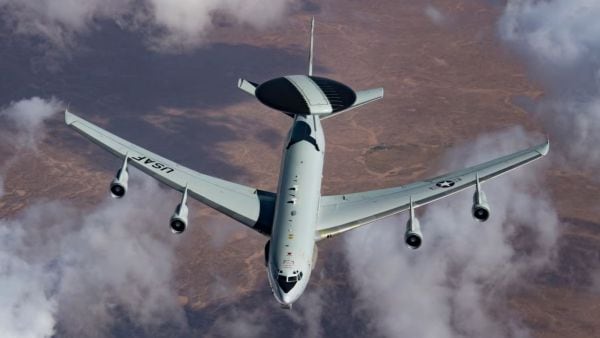 The US Air Force has only 16 of these aircraft left in its fleet. (Credit: af.mil)
According to a Congressional Research Service (CRS) report from July 2024, there are eight persistent bases and 11 other military sites that the US Department of Defense can access in the region.
While Iran has maintained that the American and Israeli establishments in the region are its “legitimate targets,” various civilian installations and energy facilities have been targeted as well. Saudi Aramco’s Ras Tanura refinery, the largest of its kind in West Asia, and its refinery in the Red Sea port of Yanbu also came under attack, in line with Tehran’s strategy of choking energy supplies from the Gulf.
Last week, the New York Times reported that Saudi Arabia’s Prime Minister, Crown Prince Mohammed bin Salman, has been urging US President Donald Trump to continue the war against Iran. The report said that Mohammed bin Salman argued the campaign presents a “historic opportunity” to reshape the region.
Why Saudi Arabia and other Gulf nations haven’t sided with Iran
Saudi Arabia’s — and the larger Gulf Arab states’ — troubled relations with Tehran go beyond the ideological Shia-Sunni divide.
Story continues below this ad
The Gulf has viewed the growth of Tehran’s conventional armed forces, its nuclear programme, and alleged hegemonic tendencies as threats since the Islamic Revolution in Iran in 1979. After the establishment of the Islamic Republic, Tehran had adopted a policy of “exporting” its revolution.
The concerns over security threats, ideological subversion, and regional instability posed by Ba’athism (in Iraq) and the revolution in Iran were among the factors that led to the birth of the Gulf Cooperation Council (GCC), an intergovernmental organisation that has largely remained aligned with Washington for its security needs.
The US-Saudi strategic partnership had been implicitly following an “oil-for-security arrangement,” where Washington provided security guarantees in exchange for stable global oil supplies from the world’s largest crude exporter. The ambit of this arrangement expanded with the creation of the GCC.
Saudi-US-Iran triangle
In 2019, the Houthis, an Iran-backed Yemeni proxy group, attacked Saudi oil facilities, temporarily knocking out half of the kingdom’s oil output. In 2022, the group attacked the Abu Dhabi International Airport in the UAE. In 2023, a China-brokered deal briefly restored diplomatic ties between Riyadh and Tehran.
Story continues below this ad
However, after the US-Israeli assault on February 28, which killed Iran’s Supreme Leader Ayatollah Ali Khamenei, Tehran retaliated with drone and missile attacks on the Gulf states.
Riyadh has been among those most alarmed in West Asia regarding Tehran’s nuclear programme. In 2018 and 2023, Prince Salman said that if Tehran built a bomb, Saudi Arabia would soon follow to deter the threat and balance power in the region.
Last month, Reuters reported that the Trump administration waived certain non-proliferation safeguards in the civil nuclear agreement with Riyadh. (The US Congress has a 90-day window to scrutinise the deal under Section 123 of the US Atomic Energy Act of 1954).
