

From a locked room to the BAC final: How Ayush Shetty stopped holding back and defeated World No 1 Kunlavut


Big, brooding Ayush Shetty had always shied away from asking for help from coaches, teammates and even parents. After a loss in Australia to Lakshya Sen last season, he didn’t tell anyone his back was in terrible pain. After a defeat at Swiss Open, he snapped his racquet into two as if the wand had no magic, and locked himself in a room for close to 48 hours, refusing to speak to anyone.
But in those dark depths of defeat, he quietly made up his mind to reach out to his psychologist. Along with the crackling sound of the smashed shuttle vrooming from his racquet, is the silent ambient sound of many things falling into place.
A month since that racquet was halved like a twig in anger, Ayush Shetty is in the finals of the Badminton Asia Championships, after defeating the most talented contemporary player and World No 1, Kunlavut Vitidsarn. Ayush started sluggish to lose the opening set 10-21 and the Thai would’ve believed he was on his way to the final. But the 20-year-old Indian sensationally turned things around to win the next two sets 21-19, 21-17, and became the first Indian since Dinesh Khanna in 1965 to reach the BAC finals.
ALSO READ | Ayush Shetty scores his biggest win over World No 4 Jonatan Christie – an all-round 23-21, 21-17 brilliance
If the downspiral had started at Australia, where he lost to Sen, the comeback happened at a similar stage — with almost the same situation. Leading the second set at 20-19 back then, with a back that was shot, he had checked his arm, held back a smash and played a lame drop. On Saturday at Ningbo, playing the World No 1 former world champion, he banged it straight down without a thought or a doubt.
Kunlavut with his fluid sideways footwork, anticipation and foot speed is a difficult opponent to get past. But the Indian was fearless with his forehand crosscourt smash that he plays from the deep corner, and yet gets depth that is pristine power. Having beaten World Nos 7 Li Shifeng, No 4 Jonatan Christie and No 20 besides, Ayush had the belief that he belonged.
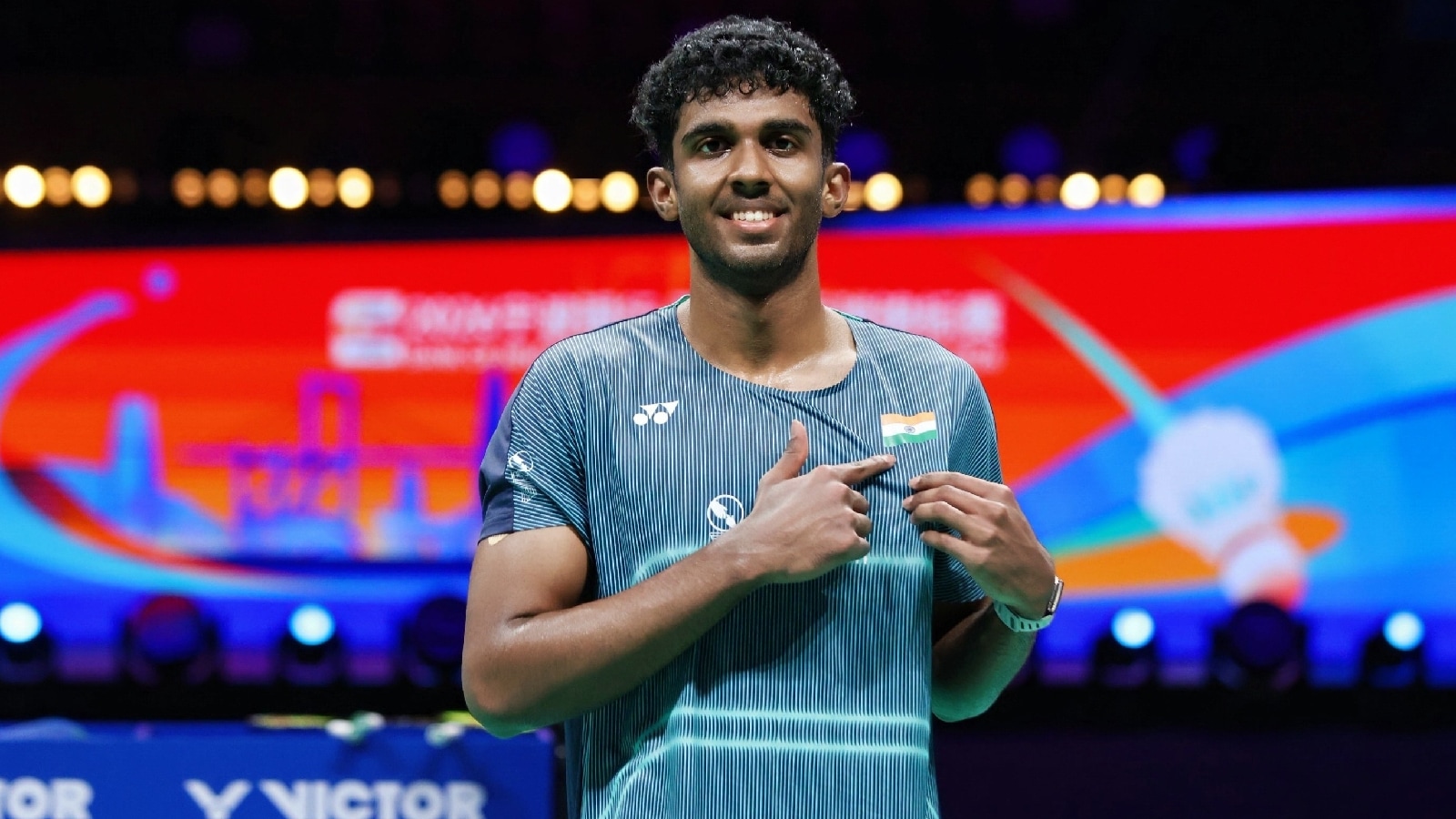 Ayush Shetty became the first Indian men’s singles player to reach the final since 1965. (Credit: Badminton Asia Championships)
Kunlavut, lulled into a feeling of dominance, had gone down 1-7 in the second with a bunch of unforced errors as Ayush made him lunge on the forehand forecourt side — a teeniest of his weaknesses. The Thai was also finding his lifts drift long. That was all Ayush needed as he made the Thai twist and turn to both flanks at high intensity and drew out errors to lead 13-7.
Story continues below this ad
Kunlavut narrowed the gap to 11-13, but once again, the Indian had that booming crosscourt smash to make it 14-11. Ayush was also prepared for the long rallies. Coach Sagar Chopda says: “At one point we thought he would start cramping but not only was he ready for long rallies, but also winning them.”
The start of this season with first-round exits had happened concurrently with Ayush doing the rounds of a back specialist. He was told he had to manage the injury with conditioning — a 45-minute pre-warmup before his one-hour warmup, for mobility and muscle activations. It’s why he was not shying away from the long rallies in the second set.
Kunlavut came from 18-20 before Ayush played a jump smash from a near eight-foot flying vantage and then rushed the net for a backhand scythe followup — just like Kidambi Srikanth used to when he defeated Lin Dan for the China Open. To win the set from 20-19, he played the glorious unchecked straight smash.
The third set saw Ayush ride the momentum as Kunlavut was broken in the mind, acutely aware of the attacking rampage. 7-2 became 11-7. By 17-10, the writing was on the wall, and Kunlavut was netting putaway smashes with a wry smile of resignation. “We had all discussed how Kunlavut will play those net tricks, keeps and pushes. Ayush in fact seemed like he was waiting for some of those shots,” Chopda says.
Story continues below this ad
Even as a junior, Ayush was known to bustle when playing a higher-ranked player. “He has always looked forward to playing bigger players. He doesn’t shy away from the big names or look for easy draws. He’d enjoy tougher matches, one after another,” Chopda says.
After a brief lull, India has a player again who doesn’t grimace at a tough draw — and suddenly, beating anyone seems possible.
