



They called him ‘Balaji.’ In a long coaching career, Monir Hossain has watched plenty of accurate mimics. The Lasith Malingas. The Brett Lees. In recent times, the Jasprit Bumrahs. Never, though, had he seen someone trying to impersonate Lakshmipathy Balaji, until he met Hasan Mahmud, his student who, 14 years later, would tame the Australians in their own backyard.
“There aren’t many Balaji impersonators even in India, are there?” enquires Hossain, in a conversation with The Indian Express from Bangladesh.
No official count exists, but the number is presumably small. Smaller still in Bangladesh.
So how did Mahmud end up idolising the former Tamil Nadu and India medium pacer?
It was the summer of 2012. Shakib Al Hasan — long before he became a divisive figure — had talked an entire nation into supporting Kolkata Knight Riders in the IPL. They won the title that year, with Shakib playing a key role.
Hasan, though, was more captivated by the team’s seamer, Balaji.
“We used to call him Balaji,” recalls Hossain. “Every kid had an idol, but Hasan was the only Balaji fan among us. A shy, soft-spoken boy — he watched Balaji at the IPL and decided he wanted to bowl just like him.”
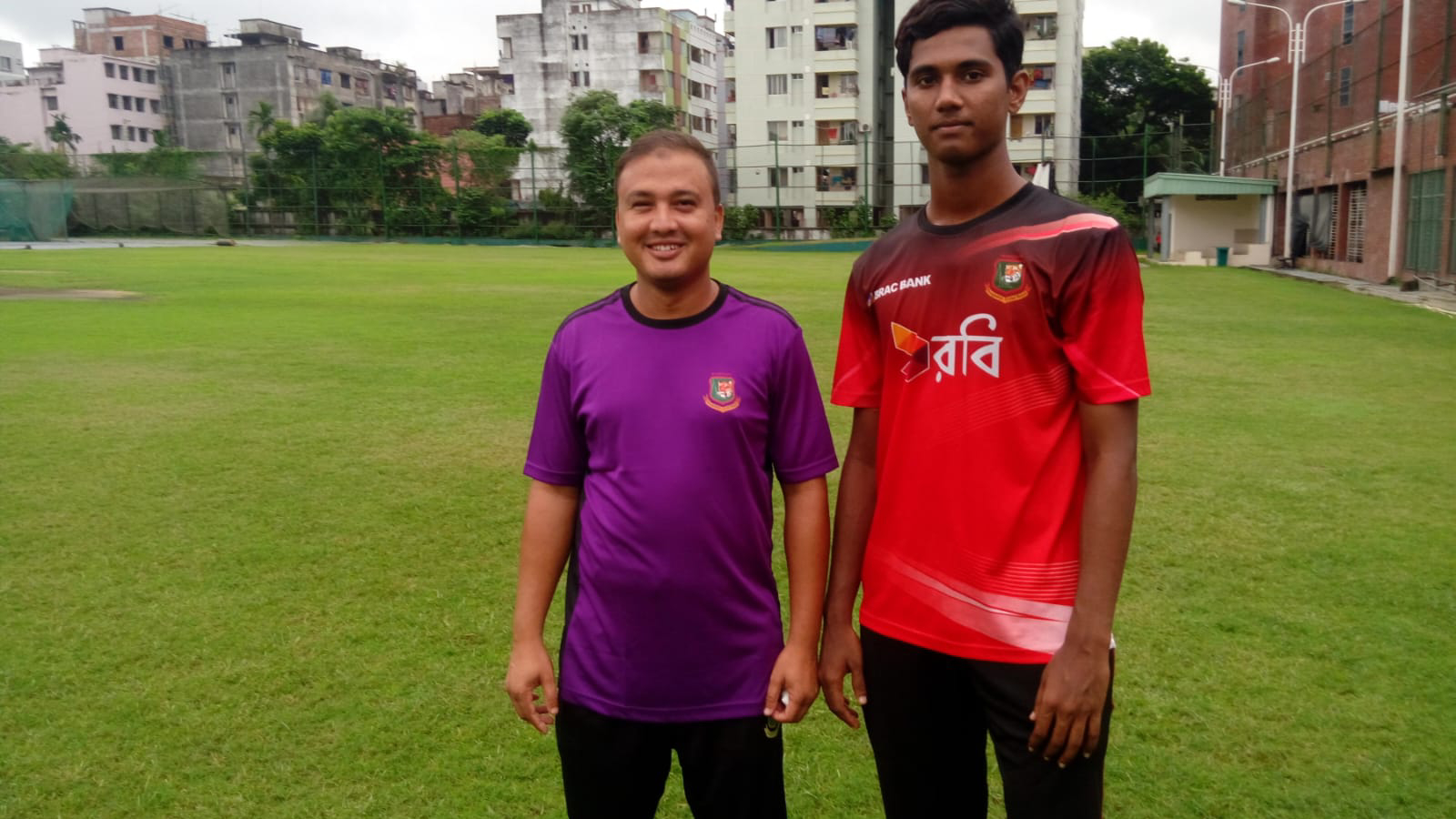 Monir Hossain with Hasan Mahmud. (Photo by special arrangement)
Mahmud’s solitary goal was to perfect the art of imitation. Hossain saw something larger.
Story continues below this ad
“Neither was he the fastest nor the strongest, but he had the gift of consistency. You mark an area for him, and he’d bowl exactly on that spot all day. I was astonished, because usually you expect kids to be wayward. Hasan wasn’t. That aside, he had a natural outswinger. I knew immediately that the kid was meant to make it big.”
He has certainly done that. Nine wickets in Darwin — the most by any Bangladeshi bowler away from home in the team’s 26-year Test history. The architect of Bangladesh’s first Test victory on Australian soil.
But before the glory came the scars. Not the visible kind.
“What people don’t know about Hasan is the many mental health battles he has fought,” his coach tells this newspaper.
The first of those was when he was only 15.
Story continues below this ad
“I got Hasan into our Lakshmipur district team, and in only his first tournament, he won us the inter-district title. That got him selected for the U-14 Chittagong Division team, and eventually, the U-15 national camp. But he was dropped from the Chittagong U-16 team soon after. This was a brutal blow, to be in the national camp and still lose your place at the division level. He swore he’d never play again.”
But he did.
“He isolated himself for four months. I kept visiting his house, kept pleading, but he wouldn’t budge. Even his parents couldn’t convince him. But I didn’t give up, and eventually, he gave in.”
Hossain’s pitch was simple: inter-division cricket would soon be beneath him, because he’d be playing for his country.
Second coming
He was proven right. Figures of 3/15 against India in an U-17 fixture at Cox’s Bazar followed. And then, another slide into darkness.
“Everything was going smoothly. The 2018 ICC U-19 World Cup was around the corner, and we were confident Hasan would make the cut. But then, he injured his shoulder while fielding in a local game. Yet again, he was devastated. Fortunately, the injury healed in time for him to play that tournament.”
Story continues below this ad
Hasan got nine wickets in the age-group World Cup. Even so, the mental health issues weren’t done with him.
Hossain recalls two major incidents. The first of them came in the very year he shone at the U-19 World Cup.
“He finished as Bangladesh’s second-highest wicket-taker at the U-19 World Cup, yet missed out on the 2018 Emerging Teams Asia Cup squad. It broke him. He locked himself in his room and stopped training altogether, convinced cricket wasn’t meant for him. I struck a deal with him — don’t quit before the 2019 Emerging Teams Asia Cup. If you’re still overlooked, do as you please.”
He was not overlooked. When the opportunity arrived, Mahmud shone. A senior team call-up seemed inevitable. But in Mahmud’s career, nothing has come easy.
Story continues below this ad
“He’s come close to quitting more than once, but the darkest stretch of all was during the pandemic. He had persistent back pain that doctors in Bangladesh couldn’t diagnose. While he could barely bowl, he watched teammates from that 2019 squad get promoted to the national side. He was certain his career was finished.”
It was not, but it could nearly have been.
“Things spiralled to the point where he stopped answering calls altogether, not just mine, but his closest friends’ too. I knew I couldn’t pull him out of it alone this time, so I went to the BCB and made the case for why they needed to step in. It took months — months in which he did nothing at all — but eventually they sent him to England, where a remedy was found.”
Mahmud has since repaid that faith many times over.
“I used to tell him ‘There will be a day you’ll make Bangladesh proud.’ Now, he has brought that very team to their knees who once argued Bangladesh didn’t deserve Test status. Isn’t this the very definition of making the country proud?”
