




Japan earthquake survivors escaped the shaking. Then a mall exploded

4 min readJul 29, 2026 02:02 PM IST
A powerful 7.1-magnitude earthquake that struck southern Japan on Tuesday triggered a second disaster when a shopping mall partially collapsed in a suspected gas explosion about an hour later, killing at least 13 people and leaving several others missing as rescuers raced against time to search for survivors.
Eight people were pulled from the rubble of the partially collapsed Aeon shopping mall near Kumamoto, but three later died, news agency Reuters reported. Mall operator Aeon said four employees remained unaccounted for after checks of its roughly 2,700 staff, while seven more people were missing after a chimney collapsed at a Nippon Paper Industries factory. Authorities said hospitals were treating dozens of injured people across the region.
Prime Minister Sanae Takaichi described the rescue effort as a “race against time”, saying emergency teams were using every available resource to reach those trapped beneath collapsed buildings. Around 4,500 soldiers, along with firefighters and police personnel, have been deployed across the quake-hit region, with about 170 troops focused on rescue operations at the mall.
Mall evacuated before suspected explosion
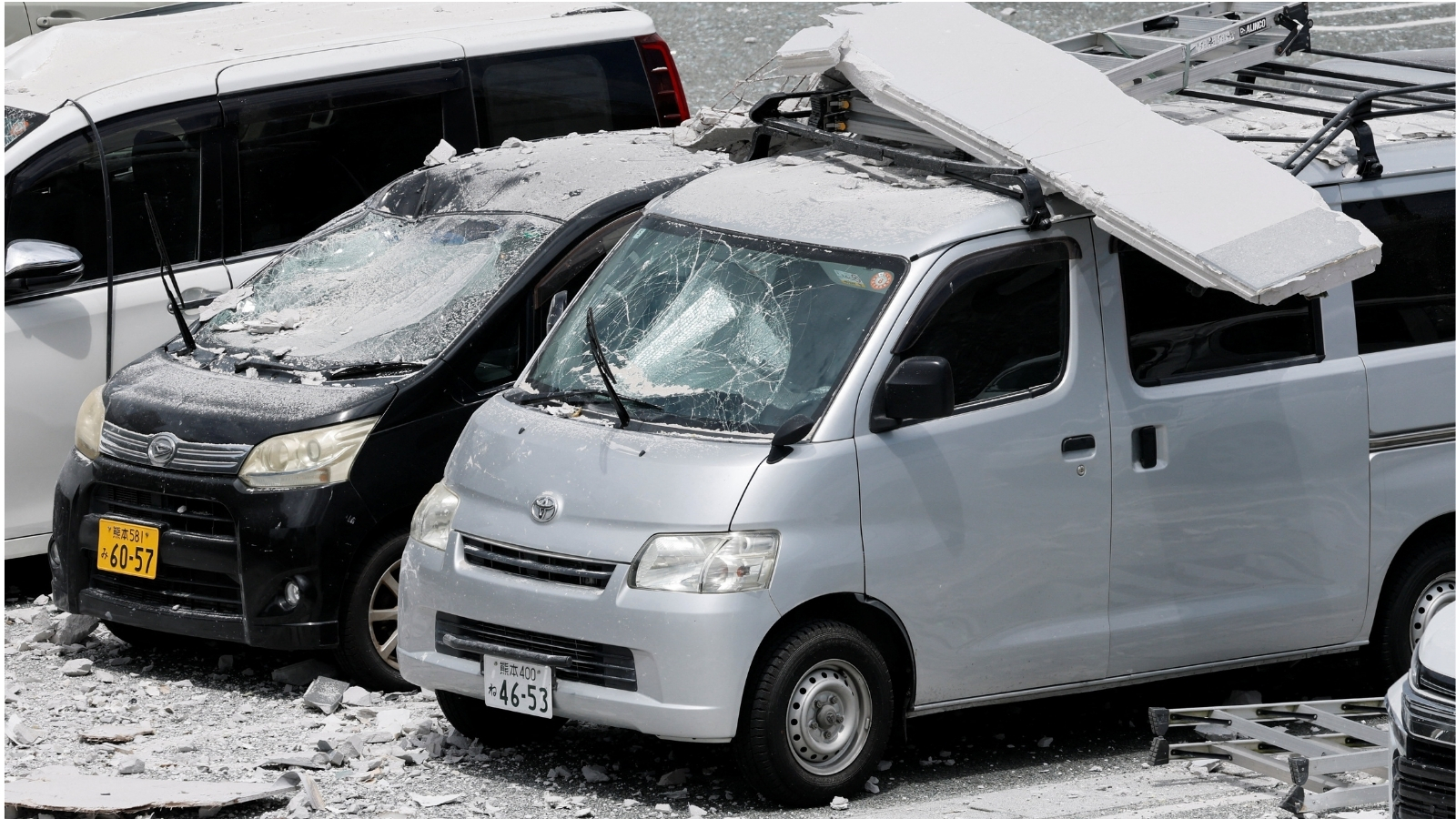
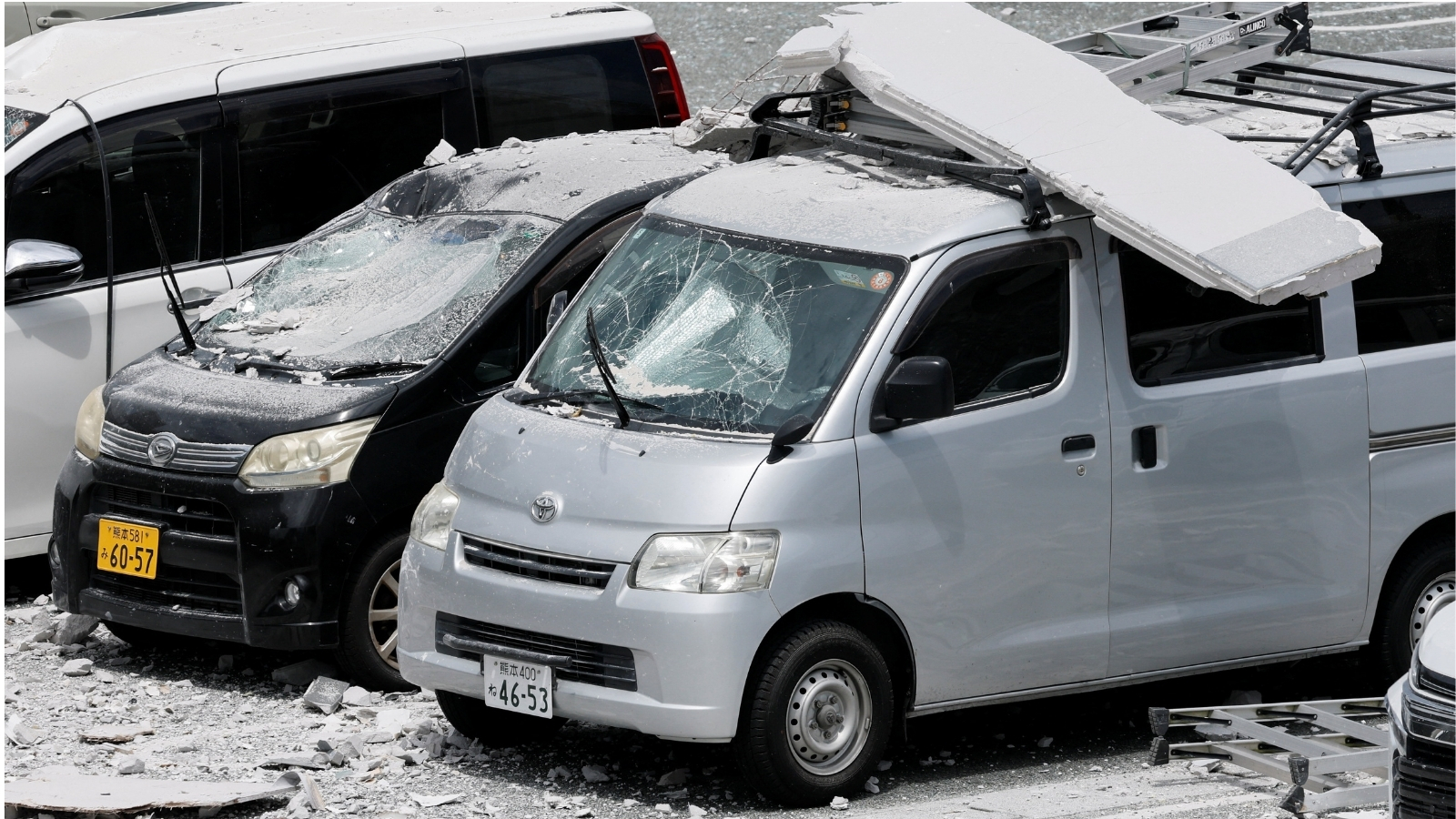
According to Reuters, hundreds of shoppers and employees had already been evacuated from the Aeon mall after the earthquake when a massive explosion ripped through the building, exposing steel beams and scattering debris across the parking area. Witnesses described scenes of panic as nearby roads became gridlocked while emergency sirens blared.
“I thought a bomb had gone off,” Reuters quoted Takateru Sonoda, who runs a nearby café and hair salon, as saying. Another witness described smoke spreading through the area “like volcanic ash” after the blast.
Police initially kept rescue teams away from the wreckage because of fears that aftershocks could trigger further collapse. More than 100 aftershocks were recorded in Kumamoto by the end of Tuesday.
.
From quake to collapse (Tuesday)
.
~4:27 pm
A 7.1-magnitude earthquake strikes Kumamoto prefecture, on Kyushu.
.
Shortly after
Shoppers and staff evacuate the Aeon Mall in Kashima town.
.
About an hour later
A suspected gas explosion tears through the mall — after customers and staff had got out, its operator says.
.
Then
Part of the building collapses, trapping people inside.
.
Into the night
Firefighters, police and troops launch a search; eight people are pulled out.
.
Wednesday
At least 13 dead across the disaster; the search for the missing goes on.
Per Japan’s PM Sanae Takaichi, the mall operator Aeon, and NHK. A developing story; the toll may change.
The disaster in numbers
7.1
magnitude
13
dead (and rising)
8
rescued from the mall
Many
staff still unaccounted for
Tens ofthousands
homes without power
Thousands
of troops deployed
Figures are still being confirmed and vary by source. Early reports of 20–30 mall staff unreachable were later described by police as “lower than that”, with the exact number unclear.
What investigators know so far
✓
The mall was evacuated after the quake.
✓
The blast came about an hour later, reported on the second floor.
✓
Rescuers reported the smell of gas inside the building.
?
A gas leak is one possible cause, a senior official said.
Not yet confirmed: Japan’s chief cabinet secretary said the detailed cause is under investigation. The gas link is a line of inquiry, not an official finding.
A region struck before
2016
A pair of major quakes (up to 7.3) hit Kumamoto.
Dozens were killed; buildings and infrastructure were badly damaged.
The region — and its landmark castle — spent years rebuilding.
2026
A 7.1 quake strikes the same prefecture on Tuesday.
A suspected gas explosion partly collapses the Aeon Mall.
The historic castle is damaged again; at least 13 are dead.
The 2016 Kumamoto earthquakes are among Japan’s most destructive of the past decade. Details of the 2026 event are still emerging.
A race against time
⚑︎
Firefighters & police
Searching the collapsed mall for those still trapped.
⛳
Thousands of troops
Mobilised by the government; PM Takaichi says “every second counts.”
⚠︎
A second site
At the Nippon Paper mill in Yatsushiro, a collapsed chimney has left several unaccounted for.
◉
Aftershocks
Strong aftershocks are complicating and slowing the rescue.
Rescue details per NHK, CNN, AFP and Al Jazeera; the operation is continuing.
Sources: Office of PM Sanae Takaichi · Aeon (mall operator) · NHK · CNN · AFP · Al Jazeera. A developing story; figures are unconfirmed and may change.
.
Gas leak under investigation
Authorities are investigating whether a gas leak triggered the explosion.
Story continues below this ad
Government spokesperson Minoru Kihara said rescue workers reported smelling gas inside the building, while emergency vehicles repeatedly warned residents to stay away from the area because of the risk of another leak. The mall used liquefied petroleum gas (LPG), which is supplied through large canisters rather than pipelines. Officials said both piped gas and LPG systems are equipped with automatic shut-off mechanisms during major seismic activity, though the exact cause of the explosion remains under investigation. Aeon declined to comment on its gas supplier or safety protocols.
Mall had reopened after 2016 earthquake
The tragedy has drawn particular attention because the shopping complex had reopened only last month after extensive redevelopment following the devastating 2016 Kumamoto earthquake.
The operator had promoted the mall’s reinforced ceilings and upgraded earthquake-resistant features as part of its reconstruction after the magnitude-7.3 quake that killed 275 people and damaged thousands of buildings a decade ago.
Widespread damage across southern Japan
The earthquake also caused widespread destruction across Kumamoto prefecture.
Story continues below this ad
Roads cracked, bridges were damaged, buildings collapsed, and fires broke out in several locations. Around 260,000 residents were advised to evacuate, while more than 36,000 homes remained without electricity amid sweltering summer temperatures. Authorities warned residents to prepare for further strong aftershocks and possible landslides over the coming week.
Several hospitals reported power outages and capacity constraints as they treated injured residents, while high-speed train services were suspended after passengers were hurt during the quake.
Manufacturing disrupted
The disaster also disrupted Japan’s manufacturing sector.
Toyota suspended operations at three factories outside Kumamoto through Friday, while Sony, Honda, Renesas Electronics and Tokyo Electron halted production at facilities in the region. Taiwan Semiconductor Manufacturing Company (TSMC) evacuated workers from its local plant as a precaution before gradually resuming operations later on Tuesday.
Story continues below this ad
Japan sits on the Pacific “Ring of Fire” and experiences about 20% of the world’s earthquakes measuring magnitude 6.0 or higher, making seismic preparedness a routine part of life. Tuesday’s disaster, however, underscored how secondary hazards such as suspected gas explosions can turn an already devastating earthquake into an even deadlier catastrophe.
(With inputs from Reuters)
