




Nepal floods: How 2 workers were rescued from a buried tunnel after 9 days | Step-by-step


When the flood came for Nepal’s Upper Trishuli 3A hydropower project, Sanjay Sah stayed behind. The 30-year-old mechanical foreman had heard that a huge surge was coming and urged colleagues to flee. But he said his responsibility was to help save the others. By the time he tried to escape himself, there was no time left, the BBC reported.
Nine days later, rescuers pulled Sah alive from a tunnel buried deep beneath the mountain.
He emerged covered in mud, an oxygen mask placed over his face as rescue workers carried him towards safety. Another worker, mechanical supervisor Kabir Maharjan, was rescued from the same tunnel. Both had been found about 170 metres inside the Upper Trishuli 3A tunnel.
Their rescue on Friday was the first confirmed breakthrough among the hydropower projects devastated by the August 26 floods. It has also revived hopes that other workers believed trapped underground may still be alive.
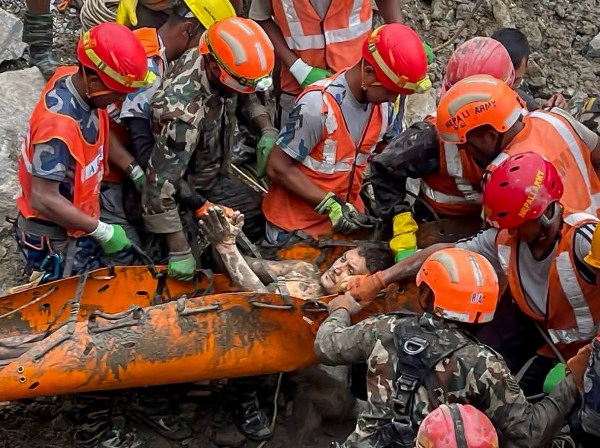 In this image received on September 4, 2026, Nepal Army personnel and other officials rescue Kabir Maharjan, 45, from a tunnel at the Trishuli 3A hydropower project 10 days after the Bhotekohi flash floods disaster, in Rasuwa district. (PTI photo)
He stayed behind to help others
Sah later told Nepali Army officials that there were normally only four to six people in the control room, but as many as 40 to 45 may have been there when the disaster struck.
He warned the workers to run after learning that the flood was coming. He never made it out. “When there was such a big accident, it was not right for me to run away,” Sah said in a video released by Nepali authorities, according to Reuters.
For nine days, he remained in darkness underground. He told rescuers that he recited mantras to keep himself going and had contact with three or four other people somewhere in the tunnel. He also said others could be trapped farther inside.
Story continues below this ad
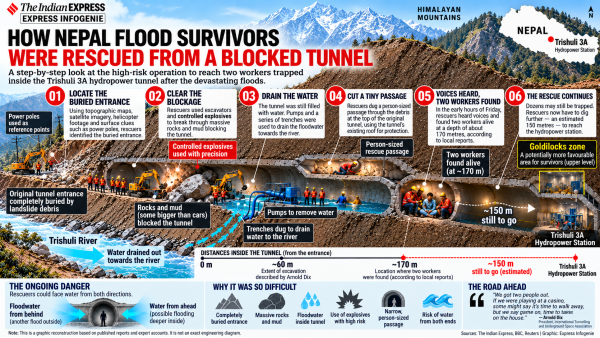 How rescuers located the buried Trishuli 3A tunnel, cleared debris, drained floodwater and cut a narrow passage to reach two workers trapped inside after Nepal’s devastating floods. (AI-generated image)
.
World · Nepal · Rescue
170 METRES UNDERGROUND
How 2 workers survived 9 days inside a Nepal tunnel
The scale of the rescue
~900
workers missing across hydropower projects
~500
believed trapped in tunnels
~115
believed trapped at Trishuli 3A
170m
inside the tunnel where the two were found
9 days
between the disaster and their rescue
The rescue, step by step
1
The flood August 26
A huge surge of water, mud and rock hits the Trishuli valley.
2
The entrance disappears
The tunnel entrance is buried beneath debris.
3
Finding the tunnel
Rescuers use old maps, satellite imagery, helicopter footage and surface landmarks to locate the entrance.
4
Digging & draining
Excavators clear enormous boulders. Pumps and drainage trenches remove water.
5
Listening for life
Rescuers hear voices deep inside the tunnel.
6
The breakthrough Sept 4, 2026
Two workers — Sanjay Sah and Kabir Maharjan — are pulled out alive after nine days.
The two men who came out
Rescued alive after nine days underground
Sanjay Sah
30
Mechanical foreman · Saptari district
Kabir Maharjan
45
Mechanical supervisor · Kathmandu
Sah stayed behind to help colleagues escape before becoming trapped himself.
Maharjan’s family said they had continued to believe he would return.
How did they survive?
Only what has been confirmed
9 days underground in the Trishuli 3A tunnel
170 m inside — found in a cable tunnel (per Arnold Dix, BBC)
Water present inside sections of the tunnel
Oxygen supplied to them during the rescue operation
Sah said he chanted mantras and had been in contact with others
Other people may still be trapped further inside the tunnel
The 170 m depth, the nine-day timeline and the survivors’ identities are confirmed by Nepali officials and international reporting. The ~900 and ~500 figures are from local authorities via AP/Reuters; the ~115 at Trishuli 3A is from Nepal’s Independent Power Producers’ Association (IPPAN). Figures are provisional; the rescue is continuing.
Sources: Nepal Army · NDRRMA · IPPAN · BBC (tunnelling expert Arnold Dix) · AP · Reuters · CNN · NBC News · CBS News. A developing story, September 2026.
.
First, rescuers had to find the tunnel
The rescue had begun with a problem that sounds simple but was anything but — the tunnel entrance had disappeared. The flood had transformed the landscape around the hydropower plant, burying the entrance beneath mud, rocks and debris.
Arnold Dix, president of the International Tunnelling and Underground Space Association and an adviser to the rescue effort, told the BBC that rescuers had never faced an operation in which they first had to work out where a tunnel entrance had gone.
They turned to whatever clues survived; old topographic maps, satellite imagery taken after the disaster, helicopter video and even surface features such as power poles.
Story continues below this ad
By comparing those pieces of information, the teams triangulated the likely location and began digging.
Then they had to find the survivors
Finding the entrance was only the beginning. The tunnel itself had been blocked by huge quantities of mud and rock. Some boulders were bigger than cars, Dix told the BBC.
Rescuers used excavators to clear the way. They also resorted to controlled explosions to break through particularly difficult sections — an unusually risky step because of the possibility that people could still be alive beyond the blockage.
Dix credited the Nepal Army with carefully managing the blasts so they would not destabilise the tunnel or endanger those trapped inside.
Story continues below this ad
Water presented another problem. As rescuers dug deeper, they found that sections of the tunnel were still flooded. Pumps were brought in, while trenches were dug from the tunnel towards the river to drain the water.
The final breakthrough
Eventually, rescuers created what Dix described as a narrow, person-sized passage through the debris near the top of the original tunnel. Then came the sound they had been waiting for.
In the early hours of Friday, rescuers heard what appeared to be voices from deep inside. According to local reports, they called out to those trapped and received a faint response.
Soon afterwards, they reached Sah and Maharjan. Images released by the Nepal Army showed one worker being carried out on a rescuer’s back, his face covered in mud, while the other was taken out on a stretcher. Both were flown to Kathmandu for treatment. Reuters reported that their vital signs were stable, although Maharjan was unable to move his hands or legs; Sah’s injuries were not considered critical.
Story continues below this ad
The rescue is far from over
The breakthrough has not ended the search. About 900 workers are reported missing from hydropower projects in the affected region, with roughly 500 believed to be trapped in tunnels, according to authorities. At Trishuli 3A alone, about 115 workers are believed to be trapped, according to the Independent Power Producers Association of Nepal.
Rescuers are also searching other hydropower sites along the Trishuli valley. At Rasuwagadhi, teams have reached about 250 metres into one tunnel before encountering a blockage. Officials believe dozens could be trapped in a chamber where they may have access to food and water.
The rescue effort is being supported by specialists from India, China and South Korea, alongside Nepali Army and police teams.
When WhatsApp became a rescue tool
The operation has also moved into the digital world. An engineers’ WhatsApp group set up before the disaster has become a real-time technical support network. It now has more than 500 members, including engineers and people familiar with the hydropower plants and their underground layouts.
Story continues below this ad
When rescuers searching the buried Chilime hydropower plant needed information, a government official asked the group for layout drawings. Minutes later, engineers supplied drawings of the powerhouse and access tunnels.
Members have also circulated the names and phone numbers of missing workers, hoping telecom data could help establish their last known locations. News agency reuters reviewed exchanges from the group and spoke to people involved in the rescue.
As Nepal Army spokesperson Raja Ram Basnet told Reuters, this is not a normal tunnel closure: the terrain and tunnel structures themselves have been altered by mud, rocks and debris.
Hope, and families still waiting
For the rescue teams, the survival of Sah and Maharjan has provided something they badly needed — evidence that people can remain alive underground for days after such a disaster.c Dix said the teams are now working towards what he calls a “Goldilocks zone” — an upper section of the hydropower station where there may be more space and potentially better conditions for life.
Story continues below this ad
But outside the tunnels, families are still waiting. Rajesh Shrestha’s 30-year-old son Rajish, an environmental engineer at Upper Trishuli 1, remains missing.
“Whenever I look outside, I imagine seeing him carrying a bag and coming home, just as he used to,” Shrestha told Reuters.
“I am surviving on the hope that he will return.”
(With inputs from BBC and agencies)
