





5 min readAug 29, 2026 11:54 AM IST
At the BCCI Centre of Excellence, Shaik Rasheed has just taken a blow to the ribs. It’s enough to floor him, force a short break, an ice pack, a moment to sit. When he gets back on his feet and returns to the nets, he asks the throwdown specialist to send the same delivery that troubled him. For the next 30-odd minutes he works through it, his back-foot cover drives the pick of the lot by the end.
It’s the influence of Joe Root in him, a batsman whose videos he watches constantly, idolises enough to have the same “66” on the back of his T-shirt. “I watch a lot of Root’s videos,” Rasheed tells The Indian Express. “I really like his back-foot punch cover drive because it is my favourite shot. When I see his batting, I learn a lot. I can connect with him. When I watch him play, I feel I’m playing. I want to learn from him how he constructs his innings in different conditions.”
ALSO READ | Shubman Gill passes SL test, but his captaincy chops are still a work in progress
On Sunday, when South Zone take on North Zone in the Duleep Trophy semi-final at the CoE in Bengaluru, Rasheed begins the new season with renewed hope that he remains among the top-order batsmen selectors are watching closely. Devdutt Padikkal has sealed the No. 3 spot for now, but the 21-year-old is among the pool being prepared for the Test team. His childhood coach, NS Ganesh, has had one message in Rasheed’s ear for seven years now: “After Virat Kohli and Rohit Sharma, you should be the one who takes their spot in the long run.”
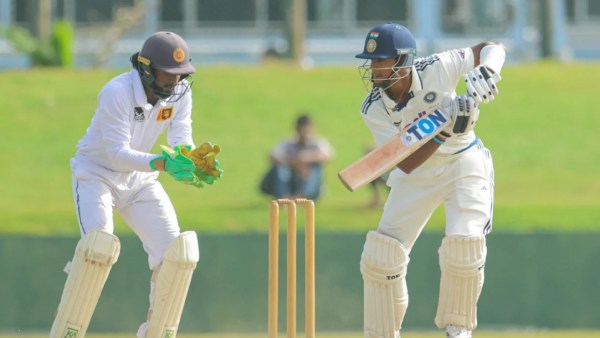 Rasheed managed 63, 20 and 45 against Sri Lanka A, but he knows those numbers aren’t enough on their own. (SLC)
Rasheed still has a long way to go. But the signs are encouraging. Having come through the India Under-19 team that won the 2022 World Cup, last Ranji season marked a coming of age for the Andhra batsman. He scored 627 runs in eight games at an average of 89.57, including three centuries and two fifties, which earned him a spot on India A’s recent tour of Sri Lanka. He managed 63, 20 and 45 against Sri Lanka A, but he knows those numbers aren’t enough on their own.
“I need to grab the opportunities. In India it is not easy to get one, and when I get a chance, I should be responsible, because there is so much competition. I want to get the Test cap. That is something I’m working towards. But at the same time, I shouldn’t get desperate. It is a process. From Under-19, I came to Ranji and now India A. So to get to the next step, I should evolve as a batsman,” he says.
Part of that evolution has meant learning to bat against the Kookaburra ball. During the A series in Sri Lanka, Rasheed admits struggling to pick the Kookaburra deliveries, and leaned on coach Hrishikesh Kanitkar for help. “I’m grateful for that A team tour, because when I went I didn’t know how to bat against the Kookaburra ball. As a top-order batsman I was struggling to pick which side the shine was on. It was a new experience for me, because I’d never played with it. So Rishi Sir helped me learn how to pick the shine. If I’m not going to pick it, then I would only be surviving,” he says.
Story continues below this ad
Rasheed credits his recent form to a habit of shadow practice before games, picked up during the IPL and continued ever since. “Before a game, I shadow practice a lot. For example, if I’m going to face Mitchell Starc in my next game, I would close my eyes, imagine he is bowling at me, and play the shots. Be it defence or playing shots, I would do everything.” He kept it up through the domestic season too, when he scored three centuries in four matches. “When it comes to domestic cricketers, I ensure that I get the videos from the analysts and ensure I follow the same routine. Visualisation plays a big role for me in the build-up to a game,” he says.
While his peers made headlines in the IPL, Rasheed, despite being with Chennai Super Kings for three seasons, played only six matches. This season he watched from home before heading to the CoE for the red-ball season. Asked if it feels like a missed opportunity, he disagrees. “The IPL was a big learning curve for me. From Mike Hussey I learned a lot, particularly from his experience of batting in different situations. It was he who taught me to take control of the game when a door opens, and how to build once you lay a platform. As a top-order batsman, these are valuable lessons for me. After a long wait, when I played the IPL, I was playing for myself rather than the team. When I get an opportunity, I would be a different batsman,” he says.
That’s the version of Rasheed nobody has seen enough of yet, the one his coach keeps insisting is coming. For now, there’s the throwdown specialist, the ball that hurt him, and the demand to have it bowled again.
