






Trump’s new Canada fight is over a lake: Why Lake Ontario was renamed

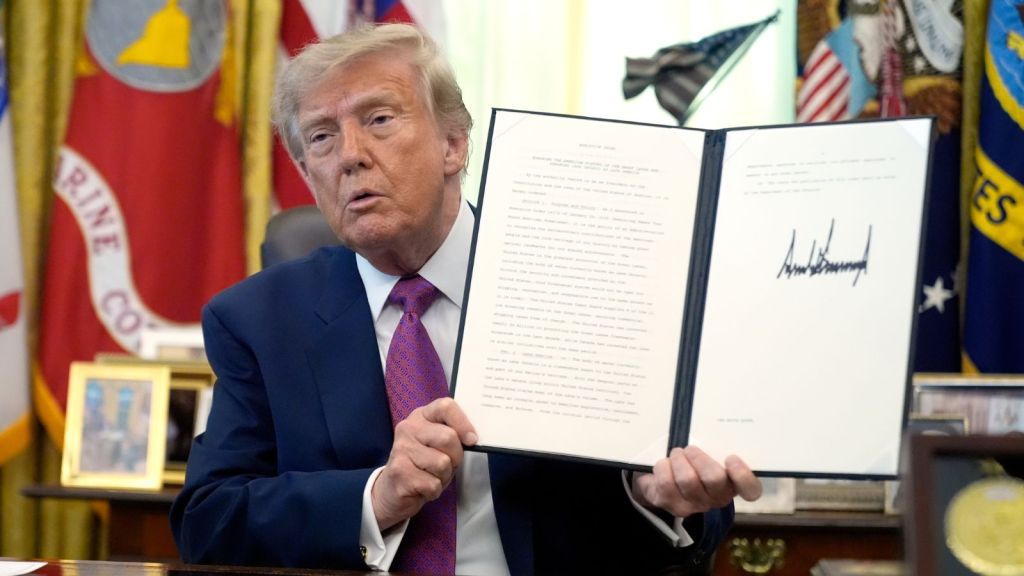
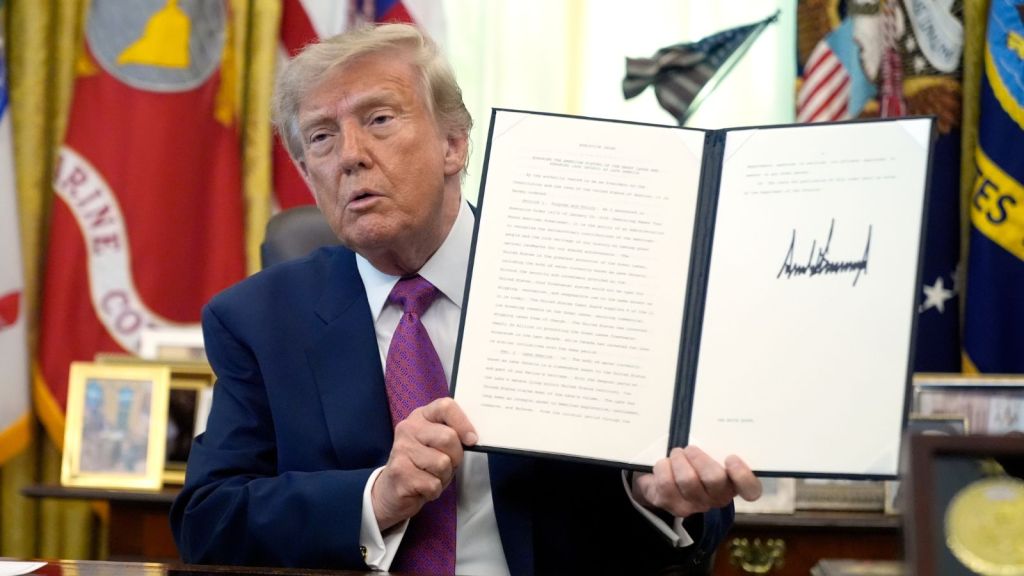 President Donald Trump holds up a signed executive order in the Oval Office of the White House. (Photo: AP)
US President Donald Trump signed an executive order on Thursday renaming Lake Ontario as ‘Lake America’, deepening his trade war with Canada, according to Associated Press (AP). The executive order provides for renaming the lake within the United States. This means the order updates the lake’s designation for the US geographic naming service, though it carries no legal weight beyond American borders and cannot compel Canada, or the rest of the world, to follow suit.
What prompted Trump to sign the order?
Trump had floated the idea for days, posting on Truth Social that Washington did not “expect to be doing much business with Ontario any longer.” The order followed a weekend in which the US imposed 50% tariffs on $20 billion worth of Canadian goods, prompting Ottawa to respond with retaliatory tariffs of its own on Tuesday, covering everything from steel and dairy to everyday household goods.
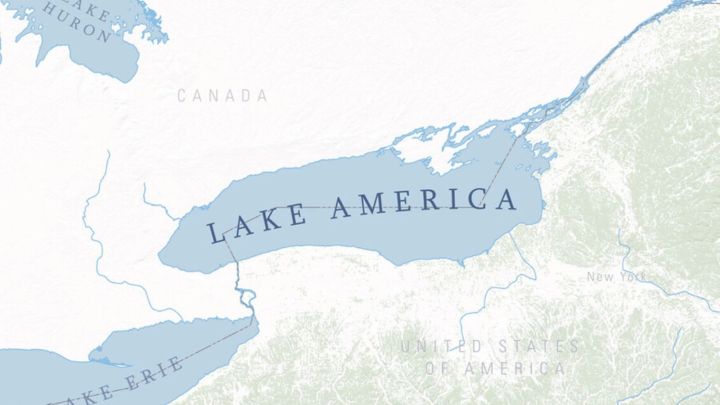
Signing the order at the Resolute Desk, with a large map reading “Lake America” propped behind him, Trump told reporters Canada had been “the worst” to deal with on trade, adding that “they feel entitled and we can’t have that.”
How did Mark Carney respond?
Canadian Prime Minister Mark Carney rejected the move in a post on X, pointing to the lake’s Indigenous roots while framing the episode as part of a broader transformation under Trump, AP reported. He explained that the name comes from the Wendat word “Ontari’io,” which he said fittingly means “the lake is beautiful, the lake is big,” noting it is more than 400 years old and predates both Canadian Confederation and the American Declaration of Independence.
The name Lake Ontario comes from the Wendat word Ontari’io, which, appropriately, means “the lake is beautiful, the lake is big”.
The name is more than 400 years old, predating both the Confederation of Canada and the Declaration of Independence of the United States of America.…
— Mark Carney (@MarkJCarney) August 27, 2026
Carney went on to suggest the renaming fits a wider pattern, remarking that America’s trading relationships, foreign policies, national monuments and now its “hydronyms” all appeared to be shifting. He closed firmly, insisting Canadians would keep calling the lake by its true name “then, now and always.”
What is Lake Ontario and who controls it?
Lake Ontario is the smallest by surface area of North America’s five Great Lakes, forming part of the border between the US state of New York and the Canadian province of Ontario. Neither country owns the lake outright; it is a shared boundary water, jointly managed under longstanding US-Canada agreements, with the International Joint Commission overseeing water levels and cross-border use.
Story continues below this ad
Ontario Premier Doug Ford also dismissed the move on social media, insisting the lake would remain “Lake Ontario to Canadians and the rest of the world. Now and forever.” Canadian historian Robert Bothwell went further, calling the renaming “a joke in an awful way” and warning that if tech companies like Apple or Google adopted the new name on their maps, it could provoke a backlash and even boycotts in Canada. Online, the reaction took a lighter turn too, with commentators noting that dropping Ontario from the Great Lakes mnemonic H-O-M-E-S would leave behind the rather fitting acronym S-H-A-M-E.
For now, the dispute remains largely symbolic. Trump’s order changes how the US government refers to the lake domestically, but Canada is under no obligation to adopt the name, and there is no single international body that decides what shared bodies of water should be called. The episode nonetheless adds to a fast-deteriorating relationship between Washington and Ottawa, with tariffs, trade retaliation and now naming disputes all playing out in the same week.
