




Why 48,000 migrants returned to Morocco after crossing into Spain’s Ceuta


Thousands of migrants who risked their lives to swim across the sea or climb border fences into Spain’s North African enclave of Ceuta are now voluntarily returning to Morocco, saying hunger, exhaustion, police restrictions and hostility from some residents shattered their hopes of reaching mainland Europe, news agency Reuters reported.
The reversal comes after one of the largest migration surges in recent European history, when an estimated 50,000 to 60,000 people crossed into Ceuta by land and sea between Thursday and Friday, overwhelming Spanish authorities. At least 67 people died, with many drowning or being crushed during the rush across the border, according to Spanish authorities.
Most of those who crossed have since returned to Morocco. Reuters reported that more than 48,000 migrants went back within 48 hours, while the Associated Press estimated that the vast majority had left voluntarily.
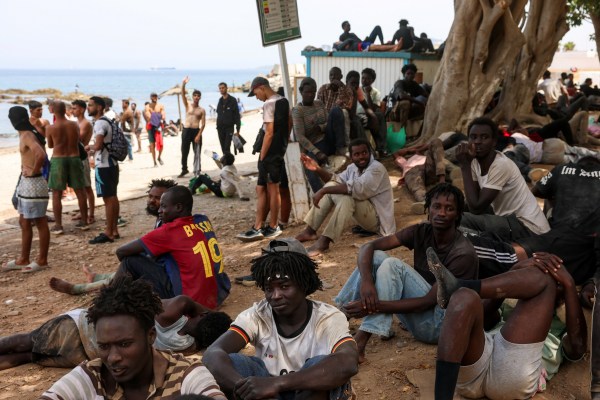 Migrants gather in Ceuta, Spain, following recent mass crossings of migrants on foot and by sea from Morocco into Spanish territory, August 1, 2026. (REUTERS)
Why are migrants returning?
For many migrants, reaching Ceuta turned out to be only the beginning of another struggle. Several migrants told Reuters they had crossed after watching viral social media videos and receiving messages suggesting that Spain’s heavily guarded border could be breached and that entry into mainland Europe would follow.
Instead, they found themselves trapped inside Ceuta. “We came to make progress, not to be fooled,” Brahim, a bakery worker from the Moroccan city of Fez, told Reuters.
“I thought I’d build a better future there. But I was surprised in Ceuta.” Brahim said he survived for three days on water alone because food had become prohibitively expensive.
“How come a tuna sandwich was being sold for 100 dirhams?” he asked.
Story continues below this ad
Others described Ceuta as effectively becoming an open-air prison. “Ceuta was like a prison — nothing to do there. Everything was closed,” another Moroccan migrant, who works at Tanger Med port, told Reuters.
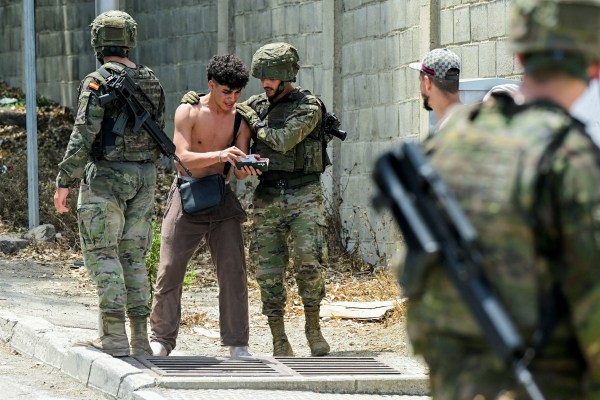 Spanish soldiers question a migrant, following mass crossings of migrants on foot and by sea from Morocco into Spanish territory, in Ceuta, August 1, 2026. (REUTERS)
Hunger, no shelter and blocked routes
Many returnees told both Reuters and AP that they struggled to find food, drinking water or shelter after entering Ceuta.
According to Reuters, supermarkets and shops remained shut for several days, forcing migrants to search for food while sleeping outdoors in soaked clothes.
The AP reported that many migrants spent nights sleeping in forests surrounding Ceuta because they could not access migrant reception centres or find accommodation.
Story continues below this ad
“I decided to come back on my own,” migrant Ouail Lamzeiz told AP.
“I spent eight days in Ceuta, and I was about to get a bed at the migrant centre, but I hadn’t eaten for days.”
Another migrant, Abdalah, who failed to cross successfully, said he remained near the border for two days without finding anything to eat.
Others said they fought over food while waiting for assistance.
Story continues below this ad
‘They wanted us to leave’
Some migrants accused residents of El Principe — a predominantly Moroccan neighbourhood in Ceuta — of driving them away.
Moroccan waiter Yassine Ichou said he was chased and assaulted. “They imposed a siege to force us to leave Ceuta by ourselves… They succeeded in their plan,” he said.
Reuters reported it could not independently verify those allegations.
Spain’s Interior Ministry said two people suffered minor injuries in separate knife attacks and one suspect had been arrested. Authorities said there had been no fatal knife attacks in Ceuta since Thursday.
Why couldn’t migrants continue to mainland Spain?
One of the biggest misconceptions among migrants was that reaching Ceuta meant automatic access to mainland Spain and the rest of Europe. Spanish authorities say that is not the case.
Story continues below this ad
According to Reuters, people leaving Ceuta by ferry or air undergo police identity checks before entering mainland Spain, creating a second layer of border control despite Ceuta being Spanish territory.
Because Spain treats Ceuta as part of its external Schengen frontier, migrants cannot simply travel onwards into mainland Spain or the passport-free Schengen area.
Spanish officials rejected claims that the country’s programme to regularise more than half a million undocumented migrants had encouraged the rush.
The government noted that applicants must prove they had been living in Spain before January 1, 2026, making new arrivals ineligible.
About 60,000 migrants from Morocco were estimated to have entered Cueta, Spain on Friday, with some swimming for hours for a chance to earn money and start a new life in a new country. This migrant spoke with CBS News’ @aidan_stretch — the only broadcast news reporter on the… pic.twitter.com/QDNBgSRsfD
— CBS News (@CBSNews) August 1, 2026
Story continues below this ad
Spain installs floating sea barrier
After restoring order, Spain began reinforcing its border with Morocco. On Saturday, Spanish Civil Guard officers started installing a 500-metre-long floating barrier off Tarajal beach — one of the main crossing points used during the mass influx.
Reuters reported that the pneumatic barrier rises between 30 and 70 centimetres above the water and extends up to one metre below the surface. Anchored naval buoys have also been deployed, while a navigation channel has been left open for Civil Guard patrol boats.
Reuters footage showed Spanish soldiers and police patrolling the now largely deserted Tarajal beach. Spanish Interior Minister Fernando Grande-Marlaska said overnight crossings had fallen to “about zero”.
Spanish troops and medics rushed to aid an exhausted migrant who collapsed on a beach in Ceuta after swimming from Morocco during an unprecedented border crisis https://t.co/lMMHqY7Bor pic.twitter.com/zJHJjeKh1D
— Reuters (@Reuters) August 1, 2026
Spain defends Morocco as a ‘reliable partner’
Questions have emerged over how tens of thousands of migrants managed to breach one of Europe’s most heavily guarded borders. However, Grande-Marlaska defended Morocco’s role, saying Rabat remained “a fully reliable partner.”
Story continues below this ad
“There was no intelligence indicating a mass entry was imminent,” he told reporters.
He credited cooperation with Moroccan authorities for helping Spain regain control of the border within 24 hours.
Spanish Prime Minister Pedro Sánchez, who visited Ceuta on Friday, described the mass crossings as a violation of Spain’s territorial sovereignty while thanking Morocco for assisting with the rapid return of migrants.
Political fallout across Europe
The Ceuta crisis has reignited debate over migration within the European Union. Twenty-two EU member states have called for an emergency meeting of interior ministers to discuss coordinated border measures, arguing that uncontrolled mass crossings could encourage further illegal migration.
Story continues below this ad
The countries also called for stronger support from the EU’s border agency, Frontex, and a review of cooperation with Morocco.
At the same time, Sánchez criticised proposals by some European politicians to suspend Spain from the Schengen passport-free zone, calling such suggestions “selfish, polarising and unlawful.”
Italy has already announced temporary border controls for travellers arriving from Spain by air and sea.
Some migrants still refuse to leave
Despite the hardships, not everyone is willing to return. Mohamed Ahmed, a Sudanese migrant, told Reuters he had swum for four hours to reach Ceuta after being dropped near the border by a truck. “I’m not going back,” he said.
“I’d rather die trying here.”
Twenty-three-year-old Moroccan Mohamed Hatri echoed that determination while speaking to AP. “They’ve closed everything down so that we can’t buy anything to eat, to force us to return to our country,” he said.
“But even if they close it down… we’re going to stay here, whether we’re hungry or not.”
(With inputs from Reuters and AP)
